
 |
 |
 |
 |
 |
 |
 |
 |
 |
 |

| . |  |
. |

Washington (AFP) Feb 15, 2011 A NASA spacecraft's flyby with a comet showed erosion on the Tempel 1's surface since it skimmed by the Sun in 2005, and revealed Tuesday the first clear pictures of the crater made by a Deep Impact probe. But the Valentine's night encounter was not easy for the US space agency's Stardust-NExT mission spacecraft, which had to fight an onslaught of debris from the comet in order to snap dozens of revealing pictures. "Comets, unlike any other body in the solar system, are unique when they are in the inner part of the solar system where the Earth is," said Don Brownlee, Stardust-NExT co-investigator. "They are literally coming apart and sending tons and tons of gas and rocks and dust out in space," he said. "They don't just spew off things in a uniform way. They send off clods of dirt and ice and rock that come apart," Brownlee said, playing audio of the impact sustained by the spacecraft. The sound was like rapid firecracker bursts. "A good analogy is thinking of a B-17 in World War II flying through flak -- sometimes a large number of impacts in less than a tenth of a second -- so it is a very dramatic environment." The pictures that Stardust snapped showed some erosion over the past five years, and for the first time allowed scientists to see the crater made by a NASA probe, an impact which was obscured by a huge dust cloud the first time around. "We never saw the crater as we went by, it was there somewhere that created a lot of mystery, it also helped to create this mission," said co-investigator Pete Schultz of Brown University. Tempel 1 was last glimpsed in 2005 by NASA's Deep Impact mission as the comet was shooting toward the Sun on its five-year orbit between Mars and Jupiter. Deep Impact pummeled the comet with a special impactor spacecraft and the material that came out was a surprise to scientists: a cloud of fine powdery material emerged, not the water, ice and dirt that was expected. Deep Impact also found evidence of ice on the surface of the comet, not just inside it. This time, the approach had to be carefully orchestrated so that the spacecraft could snap pictures of the right area of the comet at just the right moment. "We planned it so on approach we would see the Deep Impact area," said principal investigator Joe Veverka of Cornell University. "That meant arriving at precisely the right time and the right place." "We saw the crater, we really did see it," said Schultz, making a joke when an image of the crater failed to appear as prompted during a press conference. "It is subdued. It is about 150 meters across and has a small central mound in the center. It looks as if from the impact the stuff went up and came back down," he said. "This surface of the comet where we hit is very weak. It is fragile so the crater partly healed itself." The spacecraft came closest to the comet at 11:39 pm Eastern time in the United States on Monday, or 0439 GMT Tuesday, at a distance of 181 kilometers (112 miles), NASA said. The Tempel 1 is about six kilometers (3.7 miles) wide and travels on an orbit that brings it as close to the Sun as Mars and as far away as Jupiter, as they passed. Comparing pictures of the comet taken in 2005 to the latest ones, Veverka said experts could detect "erosion on a scale of twenty or thirty meters has occurred in the five years since we took this picture." Other areas seen for the first time appear to show layers of material that have been deposited, a phenomenon that deserves further study, Veverka said. "They have been interpreted as places where a very volatile gas from below the surface has erupted carrying with it small particles of ice and dust and while some of the stuff leaves into space some of it just flows downhill because a comet does have a little bit of gravity," he said. "We are seeing changes that we have to spend time quantifying to understand what they mean." The mission cost NASA about 29 million dollars. Pictures of the Tempel 1 comet are posted on NASA's website.
Share This Article With Planet Earth
Related Links Asteroid and Comet Mission News, Science and Technology

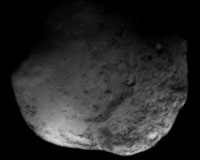 NASA'S Stardust Spacecraft Completes Comet Flyby
Pasadena CA (JPL) Feb 15, 2011 Mission controllers at NASA's Jet Propulsion Laboratory, Pasadena, Calif., watched as data downlinked from the Stardust spacecraft indicated it completed its closest approach with comet Tempel 1. An hour after closest approach, the spacecraft turned to point its large, high-gain antenna at Earth. It is expected that images of the comet's nucleus collected during the flyby will be received on Ear ... read more |
|
|
| The content herein, unless otherwise known to be public domain, are Copyright 1995-2010 - SpaceDaily. AFP and UPI Wire Stories are copyright Agence France-Presse and United Press International. ESA Portal Reports are copyright European Space Agency. All NASA sourced material is public domain. Additional copyrights may apply in whole or part to other bona fide parties. Advertising does not imply endorsement,agreement or approval of any opinions, statements or information provided by SpaceDaily on any Web page published or hosted by SpaceDaily. Privacy Statement |


 del.icio.us
 Digg
Digg Reddit
 YahooMyWeb
 Google
 Facebook


