|
 |
 |
 |
 |
 |
 |
 |
 |
 |

| . |  |
. |
NASA unveils images of Mercury overflight
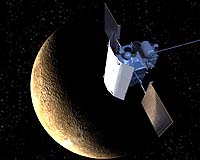
Washington (AFP) Jan 30, 2008 NASA on Wednesday unveiled images and data taken by the MESSENGER probe on its flight over unchartered terrain of Mercury, the solar system's smallest and closest planet to the sun. "This flyby allowed us to see a part of the planet never before viewed by spacecraft, and our little craft has returned a gold mine of exciting data," Sean Solomon, MESSENGER's chief investigator from the Carnegie Institution of Washington, told a press conference. "From the perspectives of spacecraft performance and maneuver accuracy, this encounter was near-perfect, and we are delighted that all of the science data are now on the ground," he added. The expert said Mercury "was not the planet we were expecting," adding that investigators found it to be "a very dynamic planet," with active volcanos and magnetosphere. The MErcury Surface, Space ENvironment, GEochemistry, and Ranging spacecraft flew by Mercury on January 14, at an altitude of 200 kilometers (124 miles), sending back more than 1,200 up-close pictures and other scientific observations of unchartered terrain. The historic fly-by was the first since the Mariner 10's March 1975 visit, when it conducted three flights over one hemisphere of Mercury using weaker observational tools. About 55 percent Mercury's surface, half of which is always facing the sun, is unknown. MESSENGER'S instruments provided a topographic profile of craters and other geological features on Mercury's dark side unique in the solar system, NASA said. The planet has huge cliffs stretching hundreds of kilometers accross its face, indicating a pattern of fault activity from the planet's early history. The craft also discovered a unique feature: more than 100 narrow, flat-floored troughs radiating from a complex central region never before seen on either Mercury or the moon that scientists dubbed "The Spider," NASA said "The Spider has a crater near its center, but whether that crater is related to the original formation or came later is not clear at this time," said James Head, science team co-investigator at Brown University in Rhode Island. MESSENGER will fly by Mercury two more times, in October 2008 and September 2009, before returning for a final sweep in 2011 when it will enter its orbit for a year-long study of the planet. The probe has already flown once past Earth and twice past Venus since its August 2004 launch. It will have travelled 7.8 billion kilometers (4.9 billion miles) when it completes its six and a half year odyssey. Community Email This Article Comment On This Article Related Links News Flash at Mercury Mars News and Information at MarsDaily.com Lunar Dreams and more
 Surprises Stream Back From Mercury's Messenger
 Laurel MD (SPX) Jan 31, 2008
After a journey of more than 2.2 billion miles and three and a half years, NASA's MESSENGER spacecraft made its first flyby of Mercury just after 2 p.m. EST on Jan. 14, 2008. All seven scientific instruments worked flawlessly, producing a stream of surprises that is amazing and delighting the science team. |
|
|

| The content herein, unless otherwise known to be public domain, are Copyright 1995-2007 - SpaceDaily.AFP and UPI Wire Stories are copyright Agence France-Presse and United Press International. ESA Portal Reports are copyright European Space Agency. All NASA sourced material is public domain. Additional copyrights may apply in whole or part to other bona fide parties. Advertising does not imply endorsement,agreement or approval of any opinions, statements or information provided by SpaceDaily on any Web page published or hosted by SpaceDaily. Privacy Statement |