include"/home2/www/vhosts/spacewar.com/swxphp/swxphp-start.php" ?>
NKorea warns on nukes after talks collapse![]() North Korea's nuclear negotiator, Vice Foreign Minister Kim Kye-Gwan. Key points from China-Japan-SKorea summit Leaders of China, Japan and South Korea on Saturday held an inaugural three-way summit at which they pledged cooperation to alleviate the global financial crisis. Herewith key points from the leaders' agreements: NKorea warns of slowdown in denuclearisation: report North Korea's negotiator warned Saturday that the communist state would slow down its work on ending its nuclear drive after the United States cut off aid, according to a report. Six-nation nuclear talks broke down Thursday in Beijing as the United States pressed North Korea to verify its denuclearisation. In response, Washington said it was suspending fuel aid as part of a nuclear deal. North Korea's vice foreign minister and nuclear negotiator, Kim Kye-Gwan, played down the importance of the US shipments. "For us, it is alright whether they are stopped or given," Kim told reporters at Beijing's airport, as quoted by Japan's Kyodo News. "If they are not provided, we will adjust the speed of disablement," he said. His remarks came as the leaders of China, Japan and South Korea held a rare summit and called for a resumption of the disarmament talks. Moscow will meet its fuel quota for North Korea: report Moscow announced Saturday it would furnish its entire fuel aid quota for North Korea, after the US said it would halt fuel shipments until Pyongyang agreed to nuclear verification protocols. "We hope to complete shortly all of our quota of 200,000 tonnes" of fuel, deputy Russian foreign minister Alexei Borodavkin told Ria Novosti news agency, describing himself as "surprised" by Washington's stance. "We hope that all the parties implicated in the six-party settlement will respect their engagements," he said, referring to negotiations to end North Korea's nuclear program. On Friday, State Department spokesman Sean McCormack said the United States would cut off the fuel aid shipments -- part of a 2007 disarmament deal with energy-strapped North Korea -- without the verification procedures. |
The leaders of China, Japan and South Korea -- half of the group involved in the North Korean disarmament talks -- all voiced hope for the negotiations as they held a rare joint summit in the southwestern Japanese province of Fukuoka.
The six-way talks -- which also involve the United States, Russia and North Korea itself -- broke down Thursday in Beijing as the United States pressed North Korea for verification of its denuclearisation activities.
In response, Washington said that North Korea's negotiating partners were suspending shipments of fuel to impoverished Pyongyang, which were part of last year's disarmament deal.
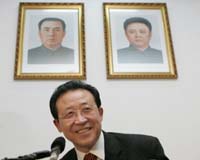
North Korea's nuclear negotiator, Vice Foreign Minister Kim Kye-Gwan, played down the US response as he spoke to reporters at Beijing's airport, according to Japan's Kyodo News.
But he warned: "If (fuel shipments) are not provided, we will adjust the speed of disablement."
The collapse of the six-way talks all but ended the hopes of US President George W. Bush's administration for a last-minute diplomatic success before Obama takes office on January 20.
South Korean President Lee Myung-Bak said he expected negotiations on North Korea to resume after Obama settles in at the White House.
"Once the United States has the Obama administration, full-fledged discussions are expected," Lee told a joint news conference after the summit with the Japanese and Chinese premiers.
"The North Korean nuclear issue turned out to be 10 years of disappointment, but it is also true that we have progressed little by little," Lee said.
"The participants of the six-party talks should work together with patience," he said. "It may take time but this is an issue which we should and can resolve."
Bush once branded North Korea part of an "axis of evil" but his administration later led the push for the aid-for-disarmament deal, overriding criticism from some US conservatives and policymakers in Japan, which has tense relations with Pyongyang.
Lee, Japanese Prime Minister Taro Aso and Chinese President Wen Jiabao issued a joint call for a resumption of diplomacy to end North Korea's nuclear drive.
"The three countries will make concerted efforts with other relevant parties to push forward the process of the six-party talks," they said in a statement after their summit.
In a separate meeting earlier in the day, Aso and Lee voiced regret over North Korea's "refusal to discuss verification" of its nuclear disarmament, a Japanese official said.
"But they agreed to continue to cooperate closely in the six-nation talks as the verification issue is very important in pressing ahead with North Korean denuclearisation," the official said.
Even before the talks broke down, Japan had refused to provide any fuel aid to North Korea. Japan has pressed Pyongyang to investigate further the fate of Japanese civilians it kidnapped in the 1970s and 1980s to train its spies.
Share This Article With Planet Earth
del.icio.us |
Digg |
Reddit |
YahooMyWeb |
Google |
|
Washington (AFP) Dec 12, 2008| The content herein, unless otherwise known to be public domain, are Copyright 1995-2007 - SpaceDaily.AFP and UPI Wire Stories are copyright Agence France-Presse and United Press International. ESA Portal Reports are copyright European Space Agency. All NASA sourced material is public domain. Additional copyrights may apply in whole or part to other bona fide parties. Advertising does not imply endorsement,agreement or approval of any opinions, statements or information provided by SpaceDaily on any Web page published or hosted by SpaceDaily. Privacy Statement |