|
 |
 |
 |
 |
 |
 |
 |
 |
 |

| . |  |
. |
NSF Builds 21 Tesla Superconducting Magnet
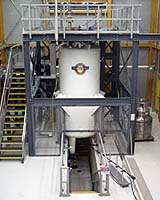
Tallahassee FL (SPX) Jul 27, 2004 The National High Magnetic Field Laboratory, funded by the National Science Foundation and the State of Florida, has achieved another world record in magnet development with the successful testing of its 21.1 Tesla, superconducting, ultra-wide bore, NMR magnet. The magnet reached full field on July 21, 2004, and will remain at field for years - and even decades - to come. A team of engineers headed by Denis Markiewicz, Tom Painter, Iain Dixon, and Jim Ferner at the NHMFL developed, designed, manufactured, and tested the magnet system. The product of this 13-year effort stands 16 feet tall, weighs over 30,000 pounds, and has a stored energy of 40 megajoules. No other magnet in the world can produce 21.1 Tesla for NMR and MRI science in a 105 mm warm bore. NHMFL Director Greg Boebinger said, "This very powerful and ultra-wide bore magnet was an extremely challenging system to build, and it represents a significant engineering accomplishment. It is the crown jewel of the laboratory's NMR spectroscopy and imaging program - a joint effort between the National High Magnetic Field Laboratory in Tallahassee and in Gainesville." This accomplishment positions the NHMFL as an international leader in the development of high field superconducting magnet technology for magnetic resonance applications. The magnet is a concentric assembly of ten superconducting coils connected in series and operated at 1.7 K (-456.6 Fahrenheit). Each coil is wound with a monolithic superconductor, composed of either niobium-tin (Nb3Sn) or niobium-titanium (NbTi) filaments in a copper matrix. To support the magnetic loading, the coils are configured with stainless steel overbanding and are vacuum impregnated with cryogenically tough epoxy for structural support. The high current density coils produce a uniform field of 21.1 Tesla to one part in one billion in a volume 64 times larger than that of typical NMR systems. Small adjustments to field homogeneity are achieved with a set of superconducting shim coils that fine tune the magnetic field. Fabrication of the NbTi and shim coils occurred in cooperation with an industrial partner, Intermagnetics General Corporation. The achievement of producing a uniform 21.1 Tesla field in a warm bore of 105 mm is attributed to the development of state-of-the-art magnet technology at the NHMFL and in collaboration with industry. "We are extremely excited about the prospects of exploring new avenues in chemical and biomedical science with this one-of-a-kind magnet system that will have an operating frequency of 900 MHz for Nuclear Magnetic Resonance (NMR) spectroscopy and Magnetic Resonance Imaging (MRI)," stated NMR Director Tim Cross. The ultra-wide bore (105 mm) is the unique aspect of this magnet that will permit a much greater range of scientific experiments than would be possible in standard 52 mm bore magnets. Science performed on this unique national resource will range from materials research to macromolecular biological structure determination and non-invasive magnetic resonance imaging of laboratory animals. With this instrument, scientists from around the world as well as those at the NHMFL will be able to expand the horizons of scientific investigation with NMR and MRI technologies. Related Links National High Magnetic Field Laboratory Los Alamos' NHMFL SpaceDaily Search SpaceDaily Subscribe To SpaceDaily Express  Quantum Computing, Secure Communication Closer
 Los Angeles CA (SPX) Jul 22, 2004
Quantum computing, which holds the promise of nearly unlimited processing power, secure communications and the ability to decode encrypted conversations by terrorists and others, is a significant step closer to becoming a reality today with new research published by a team of UCLA scientists in the journal Nature. |
|
|

| The content herein, unless otherwise known to be public domain, are Copyright 1995-2006 - SpaceDaily.AFP and UPI Wire Stories are copyright Agence France-Presse and United Press International. ESA PortalReports are copyright European Space Agency. All NASA sourced material is public domain. Additionalcopyrights may apply in whole or part to other bona fide parties. Advertising does not imply endorsement,agreement or approval of any opinions, statements or information provided by SpaceDaily on any Web page published or hosted by SpaceDaily. Privacy Statement |