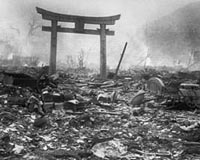
The Japanese city of Nagasaki on Sunday commemorated the 75th anniversary of its destruction by a US atomic bomb, with its mayor and the head of the United Nations warning against a nuclear arms race.
Nagasaki was flattened in an atomic inferno three days after Hiroshima — twin nuclear attacks that rang in the nuclear age and gave Japan the bleak distinction of being the only country to be struck by atomic weapons.
Survivors, their relatives and a handful of foreign dignitaries attended a remembrance ceremony in Nagasaki where they called for world peace.
Participants offered a silent prayer at 11:02 am (0202 GMT), the time the second and last nuclear weapon used in wartime was dropped over the city.
"The true horror of nuclear weapons has not yet been adequately conveyed to the world at large" despite decades of effort by survivors telling of their "hellish experience", Nagasaki mayor Tomihisa Taue said in a speech afterwards.
"If, as with the novel coronavirus — which we did not fear until it began to spread among our immediate surroundings — humanity does not become aware of the threat of nuclear weapons until they are used again, we will find ourselves in an irrevocable predicament."
UN Secretary General Antonio Guterres, in a message read by his undersecretary Izumi Nakamitsu, warned that "the prospect of nuclear weapons being used intentionally, by accident or miscalculation, is dangerously high."
"The historic progress in nuclear disarmament is in jeopardy… This alarming trend must be reversed," he said.
– 'Nuclear-free world' –
The number of participants in this year's ceremony was reduced to roughly one tenth the figure in previous years due to coronavirus fears, with proceedings broadcast live online in Japanese and English.
Prime Minister Shinzo Abe refreshed his pledge that Japan would lead "the international community's efforts towards the realisation of a nuclear-free world".
Terumi Tanaka, 88, who was 13 and at his hillside home when the bomb hit Nagasaki, remembers the moment everything went white with a flash of light, and the aftermath.
"I saw many people with terrible burns and wounds evacuating … people who were already dead in a primary school-turned shelter," Tanaka told AFP in a recent interview, saying his two aunts died.
Atomic bomb survivors "believe that the world must abandon nuclear arms because we never want younger generations to experience the same thing", he said.
The remembrance comes as worries linger over the nuclear threat from North Korea and growing tensions between the US and China over issues including security and trade.
"I'm determined to keep appealing (to the world) that Nagasaki must be the last atomic bomb-hit city," survivor Shigemi Fukahori, 89, said at the ceremony.
"I hope young people will receive this baton of peace and keep running."
The US dropped the first atomic bomb on Hiroshima on August 6, 1945, killing around 140,000 people. The toll includes those who survived the explosion itself but died soon after from radiation exposure.
Three days later, the US dropped a plutonium bomb on the port city of Nagasaki, killing 74,000 people.
Japan announced its surrender in World War II on August 15, 1945.
The United States has never acceded to demands in Japan for an apology for the loss of innocent lives in the atomic bombings, which many Western historians believe were necessary to bring a quick end to the war and avoid a land invasion that could have been even more costly.
Others see the attacks as unnecessary and even experimental atrocities.
Last year, Pope Francis met with several survivors on visits to Hiroshima and Nagasaki, paying tribute to the "unspeakable horror" suffered by the victims.
In 2016, Barack Obama became the first sitting US president to visit Hiroshima. He offered no apology for the attack but embraced survivors and called for a world free of nuclear weapons.
'Unspeakable horror': the attacks on Hiroshima and Nagasaki
Tokyo (AFP) Aug 9, 2020 –
Japan on Sunday marks 75 years since the atomic bomb attack on Nagasaki, which killed around 74,000 people and left many more deeply traumatised and even stigmatised.
It followed the bombing of Hiroshima on August 6, 1945 that killed 140,000 people.
Here are some facts about the devastating attacks:
– The bombs –
The first atomic bomb was dropped on the western city of Hiroshima by the US bomber Enola Gay.
The bomb was nicknamed "Little Boy" but its impact was anything but small.
It detonated about 600 metres from the ground, with a force equivalent to 15,000 tonnes of TNT.
Tens of thousands died instantly, while others succumbed to injuries or illness in the weeks, months and years that followed.
Three days later the US dropped a second bomb, dubbed "Fat Man", on the city of Nagasaki.
The attacks remain the only time atomic bombs have been used in wartime.
– The attacks –
When the bomb was dropped on Hiroshima, the first thing people noticed was an "intense ball of fire", according to the International Committee of the Red Cross (ICRC).
Temperatures near the blast reached an estimated 7,000 degrees Celsius (12,600 Fahrenheit), which caused fatal burns within a radius of about three kilometres (five miles).
ICRC experts say there were cases of temporary or permanent blindness due to the intense flash of light, and subsequent related damage such as cataracts.
A whirlwind of heat generated by the explosion also ignited thousands of fires that burned several square kilometres (miles) of the largely wooden city. A firestorm that consumed all available oxygen caused more deaths by suffocation.
It has been estimated that burn- and fire-related casualties accounted for more than half of the immediate deaths in Hiroshima.
The explosion generated an enormous shock wave that in some cases literally carried people away. Others were crushed to death inside collapsed buildings or injured or killed by flying debris.
"I remember the charred bodies of little children lying around the hypocentre area like black rocks," Koichi Wada, a witness who was 18 at the time of the Nagasaki attack, has said of the bombing.
– Radiation effects –
The bomb attacks unleashed radiation that proved deadly both immediately and over the longer term.
Radiation sickness was reported in the aftermath by many who survived the initial blasts and firestorms.
Acute radiation symptoms include vomiting, headaches, nausea, diarrhoea, haemorrhaging and hair loss, with radiation sickness fatal for many within a few weeks or months.
Bomb survivors, known as "hibakusha", also experienced longer-term effects including elevated risks of thyroid cancer and leukaemia, and both Hiroshima and Nagasaki have seen elevated cancer rates.
Of 50,000 radiation victims from both cities studied by the Japanese-US Radiation Effects Research Foundation, about 100 died of leukaemia and 850 suffered from radiation-induced cancers.
The group found no evidence however of a "significant increase" in serious birth defects among survivors' children.
– The aftermath –
The twin bombings dealt the final blow to imperial Japan, which surrendered on August 15, 1945, bringing an end to World War II.
Historians have debated whether the devastating bombings ultimately saved lives by bringing an end to the conflict and averting a ground invasion.
But those calculations meant little to survivors, many of whom battled decades of physical and psychological trauma, as well as the stigma that sometimes came with being a hibakusha.
Despite their suffering and their status as the first victims of the atomic age, many survivors were shunned — in particular for marriage — because of prejudice over radiation exposure.
Survivors and their supporters have become some of the loudest and most powerful voices opposing the use of nuclear weapons, meeting world leaders in Japan and overseas to press their case.
Last year, Pope Francis met several hibakusha on visits to Hiroshima and Nagasaki, paying tribute to the "unspeakable horror" suffered by victims of the attacks.
In 2016, Barack Obama became the first sitting US president to visit Hiroshima. He offered no apology for the attack, but embraced survivors and called for a world free of nuclear weapons.