|
 |
 |
 |
 |
 |
 |
 |
 |
 |

| . |  |
. |
Nanotechnologists' New Plastic Can See In The Dark
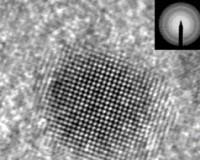
Toronto QC (SPX) Jan 19, 2005 Imagine a home with "smart" walls responsive to the environment in the room, a digital camera sensitive enough to work in the dark, or clothing with the capacity to turn the sun's power into electrical energy. Researchers at University of Toronto have invented an infrared-sensitive material that could shortly turn these possibilities into realities. In a paper to be published on the Nature Materials website Jan. 9, senior author Professor Ted Sargent, Nortel Networks � Canada Research Chair in Emerging Technologies at U of T's Department of Electrical and Computer Engineering, and his team report on their achievement in tailoring matter to harvest the sun's invisible rays. "We made particles from semiconductor crystals which were exactly two, three or four nanometres in size. The nanoparticles were so small they remained dispersed in everyday solvents just like the particles in paint," explains Sargent. Then, they tuned the tiny nanocrystals to catch light at very long wavelengths. The result � a sprayable infrared detector. Existing technology has given us solution-processible, light-sensitive materials that have made large, low-cost solar cells, displays, and sensors possible, but these materials have so far only worked in the visible light spectrum, says Sargent. "These same functions are needed in the infrared for many imaging applications in the medical field and for fiber optic communications," he said. The discovery may also help in the quest for renewable energy sources. Flexible, roller-processed solar cells have the potential to harness the sun's power, but efficiency, flexibility and cost are going to determine how that potential becomes practice, says Josh Wolfe, Managing Partner and nanotechnology venture capital investor at Lux Capital in Manhattan. Wolfe, who was not part of the research team, says the findings in the paper are significant: "These flexible photovoltaics could harness half of the sun's spectrum not previously accessed." Professor Peter Peumans of Stanford University, who has reviewed the U of T team's research, also acknowledges the groundbreaking nature of the work. "Our calculations show that, with further improvements in efficiency, combining infrared and visible photovoltaics could allow up to 30 per cent of the sun's radiant energy to be harnessed, compared to six per cent in today's best plastic solar cells." U of T electrical and computer engineering graduate student Steve MacDonald carried out many of the experiments that produced the world's first solution-processed photovoltaic in the infrared. "The key was finding the right molecules to wrap around our nanoparticles," he explains. "Too long and the particles couldn't deliver their electrical energy to our circuit; too short, and they clumped up, losing their nanoscale properties. It turned out that one nanometer � eight carbon atoms strung together in a chain � was 'just right'."
University of Toronto SpaceDaily Search SpaceDaily Subscribe To SpaceDaily Express  Study Finds Advantages To Iron Nanoparticles For Environmental Clean Up
 Portland OR (SPX) Jan 17, 2005
Researchers at Oregon Health & Science University's OGI School of Science & Engineering, in collaboration with Pacific Northwest National Laboratory (PNL) and the University of Minnesota, have discovered that at least one type of nano-sized iron may be useful in cleaning up carbon tetrachloride contamination in groundwater. |
|
|

| The content herein, unless otherwise known to be public domain, are Copyright 1995-2006 - SpaceDaily.AFP and UPI Wire Stories are copyright Agence France-Presse and United Press International. ESA PortalReports are copyright European Space Agency. All NASA sourced material is public domain. Additionalcopyrights may apply in whole or part to other bona fide parties. Advertising does not imply endorsement,agreement or approval of any opinions, statements or information provided by SpaceDaily on any Web page published or hosted by SpaceDaily. Privacy Statement |