. Military Space News .
Nanotechnology Makes Supertelescopes Much More Sensitive

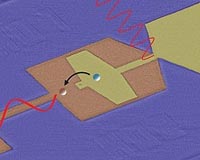
They have succeeded in drastically increasing the sensitivity of ALMA in a crucial frequency range by improving the functioning of the major component, the radiation-sensor. This involves what are known as super-conducting tunnel junctions. These miniscule sensors comprise two superconductors which are separated by an insulating layer measuring 1 to 2 nanometres, usually of aluminium oxide, with an area of 500 by 500 nanometres.
by Staff Writers
Delft, Netherlands (SPX) Feb 03, 2009
Nanotechnologist Chris Lodewijk has succeeded in significantly increasing the sensitivity of the new supertelescopes in Chile. He will receive his PhD on this topic at TU Delft on Monday 2 February.

In Chile's Atacama desert, technicians and astronomers from around the world are currently working on the Atacama Large Millimeter Array (ALMA). This consists of 66 advanced telescopes which will be placed at an altitude of 5,000 metres and together will provide a more precise image of the universe.

They are chiefly aimed at shedding light on the question of how stars and planets are formed. ALMA is expected to be taken into service in 2012 and is viewed by astronomers as a major step forward for their field.

Aluminium nitride
Dutch astronomers have been closely involved in developing ALMA in a fruitful collaboration with nanotechnologists. The latest contribution from the nano-world comes from PhD candidate Chris Lodewijk and technician Tony Zijlstra at TU Delft's Kavli Institute of Nanoscience.

They have succeeded in drastically increasing the sensitivity of ALMA in a crucial frequency range by improving the functioning of the major component, the radiation-sensor.

This involves what are known as super-conducting tunnel junctions. These miniscule sensors comprise two superconductors which are separated by an insulating layer measuring 1 to 2 nanometres, usually of aluminium oxide, with an area of 500 by 500 nanometres.

However, it is impossible to avoid a very thin layer of 1 nanometre of aluminium oxide 'leaking' in certain spots. Lodewijk and Zijlstra therefore conducted research into replacing aluminium oxide with aluminium nitride (AlN), with spectacular results. An aluminium nitride layer proves to be much more homogeneous and its sensitivity, in the 602 to 720 GHz range, is also much improved.

Herschel
Incidentally, Lodewijk's research topic of super-conducting tunnel junctions is also essential to the functioning of the Herschel Space Telescope, which is to be launched in April. The Herschel Space Telescope is the successor to the Hubble telescope. TU Delft's Kavli Institute of Nanoscience has developed many of the crucial tunnel junctions for the Herschel Telescope's measuring equipment.
Share This Article With Planet Earth
del.icio.usdel.icio.us DiggDigg RedditReddit
YahooMyWebYahooMyWeb GoogleGoogle FacebookFacebook


Related Links
Delft
Space Telescope News and Technology at Skynightly.com


Memory Foam Mattress Review
Newsletters :: SpaceDaily :: SpaceWar :: TerraDaily :: Energy Daily
XML Feeds :: Space News :: Earth News :: War News :: Solar Energy News


IAU Releases Milestone Book And Movie Celebrating The Telescope
Paris, France (ESO) Jan 24, 2009
One of the International Astronomical Union's contributions to the International Year of Astronomy 2009 is the new book and movie Eyes on the Skies - 400 Years of Telescopic Discovery, telling the fascinating story of the telescope, from its invention to the modern day. Review copies of the book, published by Wiley, and documentary movie are available for the press.


  • Chinese military chief vows nuclear, conventional build-up
  • Atlantic Eye: Obama's first 10 days
  • Obama, Hu pledge to work for more positive ties
  • World powers to hold first Iran meeting of Obama presidency

  • Analysis: Ahmadinejad does it again
  • NKorea vows to retain atomic bombs until US 'threat' ends
  • Six-party security meeting set for this month: Seoul
  • Iran defiant on nuclear programme ahead of key meeting

  • Germany Requests Addition Of Secondary Missile
  • Pakistan should exploit US missile strikes, say analysts
  • Raytheon To Upgrade Taiwan Patriot Batteries
  • ATK Awarded AARGM LRIP Contract By US Navy

  • Ballistic Missile Proliferation Part Four
  • Russia missile plans dependent on US missile defence: ministry
  • When Getting MAD Does Not Work Part Two
  • Club Of Nine Gives Missile Defense A Boost Part One

  • First China-assembled Airbus set for May test flight: report
  • New Airbus joint-venture with China announced
  • New Turbines Can Cut Fuel Consumption For Business Jets
  • Air China expects to post 'significant loss' for 2008

  • Raytheon's Unmanned Ground Control System First To Be NATO-Certified
  • Analysis: Iraqis may access UAV videos
  • Boeing Laser Avenger Shoots Down Unmanned Aerial Vehicle In Tests
  • Catapult Launch Becoming Standard Capability For Tactical UAS

  • Dogs of War: That is the question
  • Four US soldiers killed in Iraq helicopter crash
  • Iraqi PM says US troops could pull out before deadline
  • Dogs of War: Slippery slope

  • EADS Receives Contract To Build SETI Systems For Navy
  • US Navy Tests New Raytheon Warhead For JSOW C-1
  • Boeing Conducts Functional Checks Of Aussie Modified Wedgetail
  • Northrop Grumman Delivers 400th Fuselage Section For F/A-18E/F Super Hornet

  • The content herein, unless otherwise known to be public domain, are Copyright 1995-2007 - SpaceDaily.AFP and UPI Wire Stories are copyright Agence France-Presse and United Press International. ESA Portal Reports are copyright European Space Agency. All NASA sourced material is public domain. Additional copyrights may apply in whole or part to other bona fide parties. Advertising does not imply endorsement,agreement or approval of any opinions, statements or information provided by SpaceDaily on any Web page published or hosted by SpaceDaily. Privacy Statement