Imagine what Galileo would think if he could see the telescopes of the modern day and the mind-blowing sights that astronomers witness through the descendents of those first simple lenses.
Imagine what Galileo would think if he could see the telescopes of the modern day and the mind-blowing sights that astronomers witness through the descendents of those first simple lenses. |
If asked to name the invention that has done most to change the way we think about our Universe, what would you say? Undoubtedly it is the telescope, an instrument now so familiar that we take it for granted.
However, four hundred years ago when Galileo first turned his homemade arrangement of magnifying glasses to the skies and realised that Earth was not unique as had been thought, his discovery rocked the scientific world and changed our understanding of the Universe forever.
Imagine what Galileo would think if he could see the telescopes of the modern day and the mind-blowing sights that astronomers witness through the descendents of those first simple lenses.
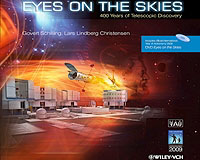
With the aim of bringing astronomy to the homes of people around the globe, the International Astronomical Union (IAU), in collaboration with Wiley VCH, The European Southern Observatory and the European Space Agency/Hubble, has produced the Eyes on the Skies - 400 Years of Telescopic Discovery book and 60-minute DVD documentary.
The movie is presented by Dr. J (aka Dr. Joe Liske) from the European Southern Observatory, host of the popular Hubblecast and ESOcast video podcasts. The book and movie is written by Dutch science journalist Govert Schilling and astronomer Lars Lindberg Christensen.
Through words and a wealth of stunning photographs, computer animations and illustrations, they tell the fascinating story of the telescope from its invention in the early 1600s to the high-tech telescopes of the near future with "eyes as large as swimming pools".
We discover how humanity's curiosity and knowledge has led to the production of larger and better telescopes allowing astronomers to uncover a host of planets and galaxies while reminding us that our view of the Universe and our place in it is still, to some extent, a mystery.
So, what is next for the telescope? As this enthralling book-movie duo reveals, there are a multitude of new projects in the pipeline, both in space and on the ground. Just looking at the images of the ESO's 42-metre European Extremely Large Telescope, the international Square Kilometre Array and the James Webb Telescope positioned a breathtaking 1.5 million kilometres beyond the Earth will leave the reader wanting to find out more.
In 2009, the International Year of Astronomy, a global effort initiated by the IAU and the United Nations Educational, Scientific and Cultural Organisation (UNESCO), will encourage the citizens of the world to "rediscover their place in the Universe through the day- and night-time sky, thereby engaging in a personal sense of wonder and discovery".
Share This Article With Planet Earth
 del.icio.us del.icio.us |
 Digg Digg |
 Reddit Reddit |
 YahooMyWeb YahooMyWeb |
 Google Google |
 Facebook Facebook |
 CSIRO Telescopes Lead Observing Marathon
 Canberra, Australia (SPX) Jan 19, 2009
| The content herein, unless otherwise known to be public domain, are Copyright 1995-2007 - SpaceDaily.AFP and UPI Wire Stories are copyright Agence France-Presse and United Press International. ESA Portal Reports are copyright European Space Agency. All NASA sourced material is public domain. Additional copyrights may apply in whole or part to other bona fide parties. Advertising does not imply endorsement,agreement or approval of any opinions, statements or information provided by SpaceDaily on any Web page published or hosted by SpaceDaily. Privacy Statement |