|
 |
 |
 |
 |
 |
 |
 |
 |
 |

| . |  |
. |
Navy Sat Ready For Monday Launch
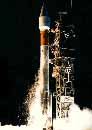
Cape Canaveral - October 14, 1998 - The ninth satellite in the UHF Follow-On series, built for the U.S. Navy by Hughes Space and Communications Company, is scheduled for launch early next Monday morning. The 120-minute launch window opens at 3:11 a.m., Oct. 19 EDT (12:11 a.m. PDT and 8:11 GMT), aboard a Lockheed Martin Atlas IIA rocket from Cape Canaveral Air Station. The satellite is a Hughes HS 601 model. UHF F9 is the second of three spacecraft configured with a Global Broadcast Service (GBS) payload. Adapted from commercial direct-to-home television technology, GBS provides high-speed, wideband broadcast signals to warfighters in all branches of the military, on land, at sea and in the air. UHF F9 will be positioned over the Atlantic Ocean, and F8 is over the Pacific. When UHF F10 is launched next year over the Indian Ocean, the Defense Department will have near-global GBS coverage. The GBS payload employs four 130-watt, 24 megabits-per-second military Ka-band transponders operating in the 30/20 GHz frequency. The information is sent to small, mobile tactical terminals. UHF F8, F9, and F10 carry the GBS package in addition to the existing UHF and EHF payloads. The UHF Follow-On satellites have replaced the Fleet Satellite Communications (FLTSATCOM) and the Hughes-built Leasat spacecraft, which had supported the Navy's global communications network serving ships at sea and a variety of other U.S. military fixed and mobile terminals. Hughes won the initial UHF Follow-On contract in July 1988 for one satellite, with options for nine more, all of which had been exercised by January 1994. In March 1996, the Navy ordered the special GBS payloads for F8, F9 and F10, bringing the total contract value to $1.85 billion.
Military Space Reports From Spacer.Com
Get Free Email At SpaceWar.Com
 Sea Launch Plans March Debut
 Long Beach - October 14, 1998 -
 Sea Launch will demonstrate the capabilities of its ocean-based commercial launch system with its first launch in March 1999, the Company said today. |
|
|

|
|
|
|
|
|
|
|
|
|
|
|
| The content herein, unless otherwise known to be public domain, are Copyright 1995-2006 - SpaceDaily.AFP and UPI Wire Stories are copyright Agence France-Presse and United Press International. ESA PortalReports are copyright European Space Agency. All NASA sourced material is public domain. Additionalcopyrights may apply in whole or part to other bona fide parties. Advertising does not imply endorsement,agreement or approval of any opinions, statements or information provided by SpaceDaily on any Web page published or hosted by SpaceDaily. Privacy Statement |