|
 |
 |
 |
 |
 |
 |
 |

| . |  |
. |

|
|
. |

 by Staff Writers Washington DC (SPX) Jul 13, 2011
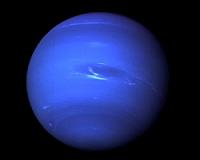
Today, Neptune has arrived at the same location in space where it was discovered nearly 165 years ago. To commemorate the event, NASA's Hubble Space Telescope has taken these "anniversary pictures" of the blue-green giant planet. Neptune is the most distant major planet in our solar system. German astronomer Johann Galle discovered the planet on September 23, 1846. At the time, the discovery doubled the size of the known solar system. The planet is 2.8 billion miles (4.5 billion kilometers) from the Sun, 30 times farther than Earth. Under the Sun's weak pull at that distance, Neptune plods along in its huge orbit, slowly completing one revolution approximately every 165 years. These four Hubble images of Neptune were taken with the Wide Field Camera 3 on June 25-26, during the planet's 16-hour rotation. The snapshots were taken at roughly four-hour intervals, offering a full view of the planet. The images reveal high-altitude clouds in the northern and southern hemispheres. The clouds are composed of methane ice crystals. The giant planet experiences seasons just as Earth does, because it is tilted 29 degrees, similar to Earth's 23-degree-tilt. Instead of lasting a few months, each of Neptune's seasons continues for about 40 years. The snapshots show that Neptune has more clouds than a few years ago, when most of the clouds were in the southern hemisphere. These Hubble views reveal that the cloud activity is shifting to the northern hemisphere. It is early summer in the southern hemisphere and winter in the northern hemisphere. In the Hubble images, absorption of red light by methane in Neptune's atmosphere gives the planet its distinctive aqua color. The clouds are tinted pink because they are reflecting near-infrared light. A faint, dark band near the bottom of the southern hemisphere is probably caused by a decrease in the hazes in the atmosphere that scatter blue light. The band was imaged by NASA's Voyager 2 spacecraft in 1989, and may be tied to circumpolar circulation created by high-velocity winds in that region. The temperature difference between Neptune's strong internal heat source and its frigid cloud tops, about minus 260 degrees Fahrenheit, might trigger instabilities in the atmosphere that drive large-scale weather changes. Neptune has an intriguing history. It was Uranus that led astronomers to Neptune. Uranus, the seventh planet from the Sun, is Neptune's inner neighbor. British astronomer Sir William Herschel and his sister Caroline found Uranus in 1781, 55 years before Neptune was spotted. Shortly after the discovery, Herschel noticed that the orbit of Uranus did not match the predictions of Newton's theory of gravity. Studying Uranus in 1821, French astronomer Alexis Bouvard speculated that another planet was tugging on the giant planet, altering its motion. Twenty years later, Urbain Le Verrier of France and John Couch Adams of England, who were mathematicians and astronomers, independently predicted the location of the mystery planet by measuring how the gravity of a hypothetical unseen object could affect Uranus's path. Le Verrier sent a note describing his predicted location of the new planet to the German astronomer Johann Gottfried Galle at the Berlin Observatory. Over the course of two nights in 1846, Galle found and identified Neptune as a planet, less than a degree from Le Verrier's predicted position. The discovery was hailed as a major success for Newton's theory of gravity and the understanding of the universe. Galle was not the first to see Neptune. In December 1612, while observing Jupiter and its moons with his handmade telescope, astronomer Galileo Galilei recorded Neptune in his notebook, but as a star. More than a month later, in January 1613, he noted that the "star" appeared to have moved relative to other stars. But Galileo never identified Neptune as a planet, and apparently did not follow up those observations, so he failed to be credited with the discovery. Neptune is not visible to the naked eye, but may be seen in binoculars or a small telescope. It can be found in the constellation Aquarius, close to the boundary with Capricorn. Neptune-mass planets orbiting other stars may be common in our Milky Way galaxy. NASA's Kepler mission, launched in 2009 to hunt for Earth-size planets, is finding increasingly smaller extrasolar planets, including many the size of Neptune.
|
. |
|
| The content herein, unless otherwise known to be public domain, are Copyright 1995-2011 - Space Media Network. AFP and UPI Wire Stories are copyright Agence France-Presse and United Press International. ESA Portal Reports are copyright European Space Agency. All NASA sourced material is public domain. Additional copyrights may apply in whole or part to other bona fide parties. Advertising does not imply endorsement,agreement or approval of any opinions, statements or information provided by Space Media Network on any Web page published or hosted by Space Media Network. Privacy Statement |

 del.icio.us
 Digg
Digg Reddit
 Google