|
 |
 |
 |
 |
 |
 |
 |
 |
 |

| . |  |
. |
Neutron Stars Join The Black Hole Jet Set
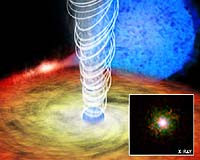
Cambridge, MA (SPX) Jun 29, 2007 NASA's Chandra X-ray Observatory has revealed an X-ray jet blasting away from a neutron star in a binary system. This discovery may help astronomers understand how neutron stars as well as black holes can generate powerful beams of relativistic particles. The jet was found in Circinus X-1, a system where a neutron star is in orbit around a star several times the mass of the Sun, about 20,000 light years from Earth. A neutron star is an extremely dense remnant of an exploded star consisting of tightly packed neutrons. Many jets have been found originating near black holes -- both the supermassive and stellar-mass variety -- but the Circinus X-1 jet is the first extended X-ray jet associated with a neutron star in a binary system. This detection shows that the unusual properties of black holes -- such as presence of an event horizon and the lack of an actual surface -- may not be required to form powerful jets. "Gravity appears to be the key to creating these jets, not some trick of the event horizon," said Sebastian Heinz of the University of Wisconsin at Madison, who led the study. The discovery of this jet with Chandra also reveals how efficient neutron stars can be as cosmic power factories. Heinz and his colleagues estimate that a surprisingly high percentage of the energy available from material falling onto the neutron star is converted into powering the jet. "In terms of energy efficiency across the Universe, this result shows that neutron stars are near the top of the list," said Norbert Schulz, a coauthor from the Massachusetts Institute of Technology in Cambridge. "This jet is almost as efficient as one from a black hole." The Chandra results also help to explain the origin of diffuse lobes of radio emission previously detected around Circinus X-1. The team found the X-ray jets of high-energy particles are powerful enough to create and maintain these balloons of radio-emitting gas. "We've seen enormous radio clouds around supermassive black holes at the centers of galaxies," said Heinz. "What's unusual here is that this pocket-sized version, relatively speaking, is being powered by a neutron star, not a black hole." The main evidence for the newly found jet comes in two extended features in the Chandra data. These two fingers of X-ray emission are separated by about 30 degrees and may represent the outer walls of a wide jet. When overlapped with radio images, these X-ray features, which are at least five light years from the neutron star, closely trace the outline of the radio jet. Another interpretation is that these two features represent two separate, highly collimated jets produced at different times by a precessing neutron star. That is, the neutron star wobbles like a top as it spins and the jet fires at different angles at different times. Jet precession is also consistent with radio observations taken at different times, which show varying orientation angles of the jet. If the precession scenario is correct, Circinus X-1 would possess one of the longest, narrowest jets found in X-ray binary systems to date, representing yet another way in which neutron stars can rival and even outdo their larger black hole relatives. These results will appear in an upcoming issue of The Astrophysical Journal Letters. NASA's Marshall Space Flight Center, Huntsville, Ala., manages the Chandra program for the agency's Science Mission Directorate. The Smithsonian Astrophysical Observatory controls science and flight operations from the Chandra X-ray Center in Cambridge, Mass. Community Email This Article Comment On This Article Related Links Chandra at Harvard Chandra at NASA Understanding Time and Space
 Black Holes That Are Not There
 Cleveland OH (SPX) Jun 20, 2007
"Nothing there," is what Case Western Reserve University physicists concluded about black holes after spending a year working on complex formulas to calculate the formation of new black holes. In nearly 13 printed pages with a host of calculations, the research may solve the information loss paradox that has perplexed physicists for the past 40 years. |
|
|

| The content herein, unless otherwise known to be public domain, are Copyright 1995-2006 - SpaceDaily.AFP and UPI Wire Stories are copyright Agence France-Presse and United Press International. ESA PortalReports are copyright European Space Agency. All NASA sourced material is public domain. Additionalcopyrights may apply in whole or part to other bona fide parties. Advertising does not imply endorsement,agreement or approval of any opinions, statements or information provided by SpaceDaily on any Web page published or hosted by SpaceDaily. Privacy Statement |