
 |
 |
 |
 |
 |
 |
 |
 |
 |
 |

| . |  |
. |

Pasadena CA (JPL) Oct 25, 2010 Recent observations of comet Hartley 2 have scientists scratching their heads, while they anticipate a flyby of the small, icy world on Nov. 4. A phenomenon was recorded by imagers aboard NASA's Deep Impact spacecraft from Sept. 9 to 17 during pre-planned scientific observations of the comet. These observations, when coupled with expected images during the closest encounter with Hartley 2 on Nov. 4, will become the most detailed look yet at a comet's activity during its pass through the inner-solar system. "On Earth, cyanide is known as a deadly gas. In space it's known as one of the most easily observed ingredients that is always present in a comet," said Mike A'Hearn of the University of Maryland, College Park. A'Hearn is principal of EPOXI, an extended mission that utilizes the already "in flight" Deep Impact spacecraft. "Our observations indicate that cyanide released by the comet increased by a factor of five over an eight-day period in September without any increase in dust emissions," A'Hearn said. "We have never seen this kind of activity in a comet before, and it could affect the quality of observations made by astronomers on the ground." The new phenomenon is very unlike typical cometary outbursts, which have sudden onsets and are usually accompanied by considerable dust. It also seems unrelated to the cyanide jets that are sometimes seen in comets. The EPOXI science team believes that astronomers and interested observers viewing the comet from Earth should be aware of this type of activity when planning observations and interpreting their data. "If observers monitoring Hartley 2 do not take into account this new phenomenon, they could easily get the wrong picture of how the comet is changing as it approaches and recedes from the sun," said A'Hearn. Cyanide is a carbon-based molecule. It is believed that billions of years ago, a bombardment of comets carried cyanide and other building blocks of life to Earth. The name EPOXI itself is a combination of the names for the two extended mission components: the extrasolar planet observations, called Extrasolar Planet Observations and Characterization (EPOCh), and the flyby of comet Hartley 2, called the Deep Impact Extended Investigation (DIXI). The spacecraft will continue to be referred to as "Deep Impact."
Share This Article With Planet Earth
Related Links EPOXI at JPL Asteroid and Comet Mission News, Science and Technology

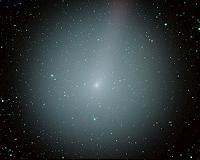 Comet Hartley 2 Visible In Morning Sky This Week
Austin TX (SPX) Oct 21, 2010 The small comet Hartley 2 makes its closest approach to Earth today and should be visible to the unaided eye for several days under dark skies in the hours before dawn, according to the editors of StarDate magazine. Early risers can take a look at the comet in anticipation of its November 4 encounter with NASA's Deep Impact spacecraft. For help in finding the comet, download a sky chart fr ... read more |
|
|
| The content herein, unless otherwise known to be public domain, are Copyright 1995-2010 - SpaceDaily. AFP and UPI Wire Stories are copyright Agence France-Presse and United Press International. ESA Portal Reports are copyright European Space Agency. All NASA sourced material is public domain. Additional copyrights may apply in whole or part to other bona fide parties. Advertising does not imply endorsement,agreement or approval of any opinions, statements or information provided by SpaceDaily on any Web page published or hosted by SpaceDaily. Privacy Statement |


 del.icio.us
 Digg
Digg Reddit
 YahooMyWeb
 Google
 Facebook


