
 |
 |
 |
 |
 |
 |
 |
 |
 |
 |

| . |  |
. |

Newark NJ (SPX) Nov 03, 2010 An international team of scientists led by Rutgers University astrophysicists have discovered 10 new massive galaxy clusters from a large, uniform survey of the southern sky. The survey was conducted using a breakthrough technique that detects "shadows" of galaxy clusters on the cosmic microwave background radiation, a relic of the "big bang" that gave birth to the universe. In a paper published in the Nov. 10 issue of Astrophysical Journal, the Rutgers scientists and collaborators at the Pontifical Catholic University of Chile (PUC) describe their visual telescope observations of these galaxy clusters, which were essential to verify the cosmic shadow sightings. Both observations will help scientists better understand how the universe was born and continues to evolve. The research began in 2008 with a new radio telescope in the Atacama Desert of Chile - one of the driest places on Earth. The instrument, known as the Atacama Cosmology Telescope (ACT), collects millimeter-length radio waves that reveal images of the otherwise invisible cosmic background radiation. Millimeter waves are easily blocked by water vapor, hence the telescope's home high in the Andes Mountains of northern Chile, where there is barely any atmospheric moisture. "The groundbreaking observations at Atacama, led by Lyman Page of Princeton University, surveyed large areas of the sky to reveal shadows that pointed astronomers to these previously unseen massive galaxy clusters," said Felipe Menanteau, a research scientist in physics and astronomy, School of Arts and Sciences, at Rutgers. Theorists Rashid Sunyaev and Yakov Zel'dovich predicted the shadow phenomenon 40 years ago, now known as the Sunyaev-Zel'dovich effect, or S-Z effect. Shortly thereafter astronomers verified it by observing shadows cast by previously known galaxy clusters. The higher sensitivity and resolution of ACT now makes it practical for astronomers to essentially reverse the procedure - to search the cosmic background radiation for shadows that indicate the presence of unseen clusters. "The 'shadows' that ACT revealed are not shadows in the traditional sense, as they are not caused by the galaxy clusters blocking light from another source," said Jack Hughes, professor of physics and astronomy at Rutgers. "Rather, the hot gases within the galaxy clusters cause a tiny fraction of the cosmic background radiation to shift to higher energies, which then makes them appear as shadows in one of ACT's observing bands." Cosmic background radiation was first observed by two Bell Labs astronomers in New Jersey back in the 1960s, a discovery that earned them the Nobel Prize in Physics in 1978. Hughes and Menanteau worked with Chilean professors Leopoldo Infante and Felipe Barrientos to collect optical images of dozens of candidates, which led to the discovery of ten entirely new massive galaxy clusters. The Rutgers and PUC team, which also included PUC undergraduate student Jorge Gonzalez, worked on two optical telescopes in Chile over the course of seven nights during October and December of 2009. "We knew the experiment was working when we could see the giant clusters clearly, even in the raw images as they came through the telescope," said Menanteau. "The technical challenges involved in exploiting the S-Z technique are daunting, and it is fantastic to see this method working so well," said Priyamvada Natarajan, professor of astronomy and physics at Yale University and a leading theoretical cosmologist not affiliated with the study. "It will build our inventory of the most massive and distant clusters in the universe, which will provide important constraints on the currently accepted cosmological model."
Share This Article With Planet Earth
Related Links Physics at Rutgers Stellar Chemistry, The Universe And All Within It

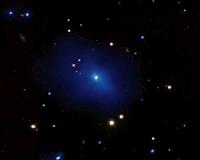 Galaxy Cluster, Quasar 3C 186
Huntsville AL (SPX) Nov 02, 2010 NASA's Chandra X-ray Observatory has observed an unusual galaxy cluster that contains a bright core of relatively cool gas surrounding a quasar called 3C 186. This is the most distant such object yet observed, and could provide insight into the triggering of quasars and the growth of galaxy clusters. This composite image of the cluster surrounding 3C 186 includes a new, deep image from Cha ... read more |
|
|
| The content herein, unless otherwise known to be public domain, are Copyright 1995-2010 - SpaceDaily. AFP and UPI Wire Stories are copyright Agence France-Presse and United Press International. ESA Portal Reports are copyright European Space Agency. All NASA sourced material is public domain. Additional copyrights may apply in whole or part to other bona fide parties. Advertising does not imply endorsement,agreement or approval of any opinions, statements or information provided by SpaceDaily on any Web page published or hosted by SpaceDaily. Privacy Statement |


 del.icio.us
 Digg
Digg Reddit
 YahooMyWeb
 Google
 Facebook


