
 |
 |
 |
 |
 |
 |
 |
 |
 |
 |

| . |  |
. |
New Horizons Detects Neptune's Moon Triton
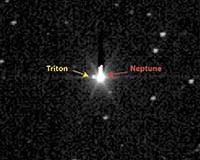
Baltimore MD (SPX) Mar 13, 2009 Add another moon to the New Horizons photo gallery: the spacecraft's Long Range Reconnaissance Imager detected Triton, the largest of Neptune's 13 known moons, during the annual spacecraft checkout last fall. New Horizons was 2.33 billion miles (3.75 billion kilometers) from Neptune on Oct. 16, when LORRI, following a programmed sequence of commands, locked onto the planet and snapped away. "We wanted to test LORRI's ability to measure a faint object near a much brighter one using a special tracking mode," says New Horizons Project Scientist Hal Weaver, of the Johns Hopkins University Applied Physics Laboratory, "and the Neptune-Triton pair perfectly fit the bill." LORRI was operated in 4-by-4 format (the original pixels are binned in groups of 16), and the spacecraft was put into a special tracking mode to allow for longer exposure times. "We needed to achieve the highest possible sensitivity," Weaver adds. Mission scientists also wanted to measure Triton itself. "Among the objects visited by spacecraft so far, Triton is by far the best analog of Pluto," says New Horizons Principal Investigator Alan Stern. The Voyager 2 spacecraft took spectacular images of Triton during its flyby of Neptune in 1989, showing evidence of cryovolcanic activity and cantaloupe-like terrain. Triton is only slightly larger than Pluto (1,700 miles [2,700 kilometers] in diameter compared to Pluto's 1,500 miles [2,400 kilometers]). Both objects have atmospheres primarily composed of nitrogen gas with a surface pressure only 1/70,000th of Earth's, and comparably cold surface temperatures (-390 degrees F on Triton and -370 degrees F on Pluto). Triton is widely believed to have once been a member of the Kuiper Belt (as Pluto still is) that was captured into orbit around Neptune, probably during a collision early in the solar system's history. New Horizons can observe Neptune and Triton at solar phase angles (the Sun-object-spacecraft angle) that are not possible to achieve from Earth-based facilities, and this unique perspective can provide insight into the properties of Titan's surface and Neptune's atmosphere. LORRI will continue to observe the Neptune-Triton pair during annual checkouts until the Pluto encounter in 2015. New Horizons is currently in electronic hibernation, 1.2 billion miles (1.93 billion kilometers) from home, speeding away from the Sun at 38,520 miles (61,991 kilometers) per hour. Share This Article With Planet Earth
Related Links New Horizons The million outer planets of a star called Sol
 NASA And ESA Prioritise Outer Planet Missions
 Paris, France (ESA) Feb 19, 2009
At a meeting in Washington last week, NASA and ESA officials decided to first pursue a mission to study Jupiter and its four largest moons, and plan for another mission to visit Saturn's largest moon, Titan, and Enceladus. |
|
|

| The content herein, unless otherwise known to be public domain, are Copyright 1995-2007 - SpaceDaily.AFP and UPI Wire Stories are copyright Agence France-Presse and United Press International. ESA Portal Reports are copyright European Space Agency. All NASA sourced material is public domain. Additional copyrights may apply in whole or part to other bona fide parties. Advertising does not imply endorsement,agreement or approval of any opinions, statements or information provided by SpaceDaily on any Web page published or hosted by SpaceDaily. Privacy Statement |
 del.icio.us
 Digg
Digg Reddit
 YahooMyWeb
 Google
 Facebook