 New Horizons Pluto Payload Ready For Flight, Exciting Science Campaign
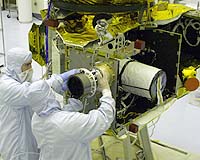
Mike Lynch of the Johns Hopkins University Applied Physics Laboratory and Benjamin Rodriguez of the Southwest Research Institute re-install the Solar Wind Around Pluto (SWAP) instrument on NASA's New Horizons spacecraft Oct. 5 at Kennedy Space Center, Fla. SWAP, one of seven instruments on the Pluto-bound New Horizons probe, had been removed for previously planned maintenance and installation of new detectors. Visible above SWAP is the Pluto Energetic Particle Spectrometer Science Investigation (PEPSSI) instrument; to the right are the telescopic Long Range Reconnaissance Imager (LORRI) and, with protective red covers, the spacecraft's star-tracking navigation cameras. Launch is scheduled during a 35-day window that opens on January 11, 2006. Credit: NASA/Johns Hopkins University Applied Physics Laboratory/Southwest Research Institute. |
San Antonio TX (SPX) Oct 19, 2005
The science payload for NASA's New Horizons mission completed its last major preparations for flight last week. The probe will be the first to visit Pluto and its moon, Charon.
The compact New Horizons spacecraft carries a payload of seven science instruments for examining the geology, composition, surface, temperature and atmospheric structure of the planet and its moon.
Flybys of one or more of the icy objects in the Kuiper Belt may be scheduled thereafter, during a mission extension.
Southwest Research Institute (SwRI) led the development of the science payload, which recently completed a series of spacecraft environmental tests in Maryland at NASA's Goddard Space Flight Center and the Johns Hopkins University Applied Physics Laboratory (APL), where the instruments were also integrated with the spacecraft.
"Although the hard work on the instrument development and testing is over, the work never stops," says New Horizons Science Payload Manager William C. Gibson, assistant vice president of the SwRI Space Science and Engineering Division. "We'll only stop worrying once we've achieved full mission success, but we're thrilled that the payload is ready for flight."
The New Horizons payload is incredibly power efficient, with the instruments collectively drawing only about 28 watts. The payload consists of three optical instruments, two plasma instruments, a dust sensor and a radio science receiver/radiometer. The individual instruments and their principal investigators (PI) are:
Alice, an ultraviolet imaging spectrometer that will probe the atmospheric composition and structure of Pluto. (Led by SwRI; PI Dr. Alan Stern)
Ralph, a visible and infrared camera that will obtain high-resolution color maps and surface composition maps of the surfaces of Pluto and Charon. (Led by Ball Aerospace and SwRI; PI Dr. Alan Stern)
LORRI, or Long Range Reconnaissance Imager, will image Pluto's surface at football-field sized resolution, resolving features as small approximately 50 yards across. (Led by APL; PI Dr. Andrew Cheng)
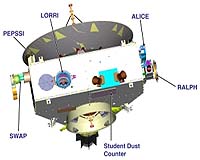
The New Horizons spacecraft carries seven science instruments, including: Alice (also shown in accompanying photo) � an ultraviolet imaging spectrometer that will probe the atmospheric composition and structure of Pluto.
Ralph � a visible and infrared camera that will obtain high-resolution color maps and surface composition maps of the surfaces of Pluto and Charon.
LORRI, or Long Range Reconnaissance Imager � will image Pluto's surface at football-field sized resolution, resolving features as small approximately 50 yards across.
SWAP, or Solar Wind Around Pluto � will measure charged particles from the solar wind near Pluto to determine whether it has a magnetosphere and how fast its atmosphere is escaping.
PEPSSI, or Pluto Energetic Particle Spectrometer Science Investigation � will search for neutral atoms that escape the planet's atmosphere and subsequently become charged by their interaction with the solar wind.
SDC, or Student Dust Counter � will count and measure the masses of dust particles along the spacecraft's entire trajectory, covering regions of interplanetary space never before sampled.
REX, or Radio Science Experiment � a circuit board containing sophisticated electronics that has been integrated with the spacecraft's radio telecommunications system, will study Pluto's atmospheric structure, surface thermal peperties, and make measurements of the mass of Pluto and Charon and KBOs.
Related Links
Southwest Research Institute
New Horizons at JHUAPL
SpaceDaily
Search SpaceDaily
Subscribe To SpaceDaily Express
 The PI's Perspective: Changes in Latitude
 Cape Canaveral FL (SPX) Oct 04, 2005
With the passing of each day in September, one could feel the season changing. In Maryland and Colorado, where I have spent about equal amounts of time the past year, the mornings are noticeably cooler and the leaves have begun to fall. So too, as the days and weeks of September passed, New Horizons planned to enter a new season as well - its launch campaign.
|
|
|

| The content herein, unless otherwise known to be public domain, are Copyright 1995-2006 - SpaceDaily.AFP and UPI Wire Stories are copyright Agence France-Presse and United Press International. ESA PortalReports are copyright European Space Agency. All NASA sourced material is public domain. Additionalcopyrights may apply in whole or part to other bona fide parties. Advertising does not imply endorsement,agreement or approval of any opinions, statements or information provided by SpaceDaily on any Web page published or hosted by SpaceDaily. Privacy Statement |
|











