|
 |
 |
 |
 |
 |
 |
 |
 |
 |

| . |  |
. |
New NASA-Japanese Telescope Images Uncharted Wavelengths
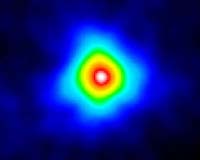
Greenbelt MD (SPX) Nov 10, 2004 Scientists using an experimental X-ray telescope suspended from a balloon have captured a unique picture of a pulsar shining in a form of light never before imaged in detail - that is, in high-energy "hard" X-rays. The observation marks a milestone in astronomical imaging. Other X-ray instruments, such as NASA's Chandra X-ray Observatory, turn lower-energy "soft" X-rays into visible images. To capture elusive hard X-rays, scientists from the United States and Japan built an instrument with new types of mirrors and detectors. This instrument, called InFOCuS (International Focusing Optics Collaboration for u-Crab Sensitivity), is a test bed for a proposed NASA satellite mission called Constellation-X. "In this new pulsar picture we are seeing aspects no one has seen before," said Dr. Hans Krimm of NASA's Goddard Space Flight Center in Greenbelt, Md., an InFOCuS project scientist. "The X-ray band of the electromagnetic spectrum is huge; and until now, we were only seeing a sliver of this - sort of like viewing the colors red and orange but not higher-energy blues and violets." The Chandra telescope does have crisper vision than InFOCuS, he said, but as these new types of mirrors are improved, high-energy X-ray images will get better and better. "Our new image is a little fuzzy, but it sure looks beautiful to us," said Krimm. InFOCuS launched on September 16 and flew for 20 hours from Fort Sumner, N. M., beneath a 1.1-million-cubic-meter (40-million-cubic-foot) balloon at 39 kilometers (128,000 feet). The pulsar it observed is a well-known target named 4U 0115+63, which is 23,000 light years away in the constellation Cassiopeia. The InFOCuS collaboration includes NASA Goddard and the universities of Nagoya (Japan), Pennsylvania, Arizona and Maryland. Visible light - the reds, greens and blues our eyes can detect - is far easier to reflect and magnify, the basic function of an optical telescope. Shine a flashlight into the mirror, and the light will bounce back. A beam of X-rays would pierce through the mirror. To reflect X-ray light onto a detector, scientists need a telescope with mirrors aligned at shallow angles to the detector. The process is like skimming a stone on water. Soft X-rays, which are less penetrating than hard X-rays, are easier to focus. Soft X-ray telescopes employ single-layer gold or glass mirrors that reflect the X-rays at very shallow angles onto a CCD, the type of detector found in common video detectors. InFOCuS team members needed to create a shallower angle and a different kind of detector, or else the hard X-rays would scatter off the mirrors or fly through the detector. The shallow angle was created with an 8-meter (26-foot) focal length between the mirrors and the detector. The mirrors are multi-layer with alternating, lightweight and excruciatingly thin bands of carbon and platinum. X-rays that penetrate one band of platinum are reflected by lower bands onto the detector. The detector is Cadmium-Zinc-Telluride, a new technology. Cosmic phenomena both beautiful and bizarre - such as star explosions and the flow of gas around a black hole - glow brightly in X-rays. Imaging these events provides insight to their structure and nature. InFOCuS is one of three major instruments pushing the limits of X-ray imaging. In 2001, the balloon-borne High Energy Replicated Optics (HERO) experiment, built by NASA Marshall Space Flight Center in Huntsville, Ala., produced images from X-ray light more energetic than what Chandra sees but less energetic than what InFOCuS sees. Another balloon-borne experiment led by Caltech - the High Energy Focusing Telescope (HEFT) - will attempt to image the highest-energy X-rays, like InFOCuS does. "These three balloon experiments represent the future of X-ray astronomy," said Dr. Jack Tueller of NASA Goddard, InFOCuS Principal ivestigator. "The beauty of balloons is that we can test these cutting-edge technologies for relatively little money. Try to imagine testing a 26-foot-long telescope any other way. We plan to fly InFOCuS several more times in the next few years." Constellation X, proposed for flight early next decade, would comprise several telescopes flying in unison with the combined light-collecting power needed to observe matter falling into black holes. Constellation X is a key mission in NASA's Beyond Einstein roadmap. NASA's Wallops Flight Facility, Wallops Island, Va., manages the Scientific Balloon Program for the NASA Office of Space Science, Science Mission Directorate. The National Scientific Balloon Facility located in Palestine, Texas, manages and conducts launch operations for NASA's scientific balloons. Hans Krimm joins NASA Goddard through funding from the Universities Space Research Association. Note on acronym: The "u" of "InFOCuS" is actually the Greek letter "mu" (m) , which denotes the prefix "micro". Related Links InFOCuS at NASA SpaceDaily Search SpaceDaily Subscribe To SpaceDaily Express  Laser Points To The Future At Palomar
 Pasadena CA (SPX) Nov 09, 2004
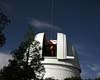
The Hale Telescope on Palomar Mountain has been gathering light from the depths of the universe for 55 years. It finally sent some back early last week as a team of astronomers from the California Institute of Technology, the Jet Propulsion Laboratory and the University of Chicago created an artificial star by propagating a 4-watt laser beam out from the Hale Telescope and up into the night sky.
--------------------------------------------------------- It's new. And it's downright terrific! Celestron's CPC Schmidt-Cassegrain telescope is the scope you've been waiting for! It offers new alignment technology, advanced engineering, and bold new design at a new, low price! In fact, Celestron's Professional Computerized (CPC) scope with revolutionary SkyAlign Alignment Technology redefines everything that amateur astronomers are looking for. It offers quick and simple alignment, GPS technology, unsurpassed optical quality, ease of use, advanced ergonomics, enhanced computerization and, most important, affordability. Want to view M-31 tonight? One button takes you there!
Shop for telescopes online at Telescopes.com! today!
|
|
|

| The content herein, unless otherwise known to be public domain, are Copyright 1995-2006 - SpaceDaily.AFP and UPI Wire Stories are copyright Agence France-Presse and United Press International. ESA PortalReports are copyright European Space Agency. All NASA sourced material is public domain. Additionalcopyrights may apply in whole or part to other bona fide parties. Advertising does not imply endorsement,agreement or approval of any opinions, statements or information provided by SpaceDaily on any Web page published or hosted by SpaceDaily. Privacy Statement |