
 |
 |
 |
 |
 |
 |
 |
 |
 |
 |

| . |  |
. |
New Red Spot Appears On Jupiter
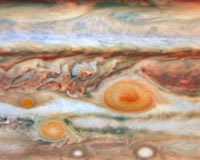
Baltimore MD (SPX) May 23, 2008 In what's beginning to look like a case of planetary measles, a third red spot has appeared alongside its cousins-the Great Red Spot and Red Spot Jr.-in the turbulent Jovian atmosphere. This third red spot, which is a fraction of the size of the two other features, lies to the west of the Great Red Spot in the same latitude band of clouds. The new red spot was previously a white oval-shaped storm. The change to a red color indicates its swirling storm clouds are rising to heights like the clouds of the Great Red Spot. One possible explanation is that the red storm is so powerful it dredges material from deep beneath Jupiter's cloud tops and lifts it to higher altitudes where solar ultraviolet radiation-via some unknown chemical reaction-produces the familiar brick color. Detailed analysis of the visible-light images taken by Hubble's Wide Field Planetary Camera 2 on May 9 and 10, and near-infrared adaptive optics images taken by the W.M. Keck telescope on May 11, is revealing the relative altitudes of the cloud tops of the three red ovals. Because all three oval storms are bright in near-infrared light, they must be towering above the methane in Jupiter's atmosphere, which absorbs the Sun's infrared light and so looks dark in infrared images. Turbulence and storms first observed on Jupiter more than two years ago are still raging, as revealed in the latest pictures. The Hubble and Keck images also reveal the change from a rather bland, quiescent band surrounding the Great Red Spot just over a year ago to one of incredible turbulence on both sides of the spot. Red Spot Jr. Appeared in spring of 2006. The Great Red Spot has persisted for as long as 200 to 350 years, based on early telescopic observations. If the new red spot and the Great Red Spot continue on their courses, they will encounter each other in August, and the small oval will either be absorbed or repelled from the Great Red Spot. Red Spot Jr. Which lies between the two other spots, and is at a lower latitude, will pass the Great Red Spot in June. The Hubble and Keck images may support the idea that Jupiter is in the midst of global climate change, as first proposed in 2004 by Phil Marcus, a professor of mechanical engineering at the University of California, Berkeley. The planet's temperatures may be changing by 15 to 20 degrees Fahrenheit. The giant planet is getting warmer near the equator and cooler near the South Pole. He predicted that large changes would start in the southern hemisphere around 2006, causing the jet streams to become unstable and spawn new vortices. The Hubble team members are Imke de Pater, Phil Marcus, Mike Wong and Xylar Asay-Davis of the University of California, Berkeley, and Christopher Go of the Philippines. The Keck team members were de Pater, Wong, and Conor Laver of the University of California, Berkeley, and Al Conrad of the Keck Observatory. The contributions by the amateur network are invaluable for this research. Community Email This Article Comment On This Article Share This Article With Planet Earth
Related Links Hubble Space Telescope Berkeley Jupiter and its Moons Explore The Ring World of Saturn and her moons The million outer planets of a star called Sol News Flash at Mercury
 The Little Red Spot Of Jupiter Has Lots Of Winds Blowing
 Laurel MD (SPX) May 23, 2008
Using data from NASA's New Horizons spacecraft and two telescopes at Earth, an international team of scientists has found that one of the solar system's largest and newest storms - Jupiter's Little Red Spot - has some of the highest wind speeds ever detected on any planet. |
|
|

| The content herein, unless otherwise known to be public domain, are Copyright 1995-2007 - SpaceDaily.AFP and UPI Wire Stories are copyright Agence France-Presse and United Press International. ESA Portal Reports are copyright European Space Agency. All NASA sourced material is public domain. Additional copyrights may apply in whole or part to other bona fide parties. Advertising does not imply endorsement,agreement or approval of any opinions, statements or information provided by SpaceDaily on any Web page published or hosted by SpaceDaily. Privacy Statement |
 del.icio.us
 Digg
Digg Reddit
 YahooMyWeb
 Google
 Facebook


