|
 |
 |
 |
 |
 |
 |
 |
 |
 |

| . |  |
. |
New Red Spot Growing Fast On Jupiter
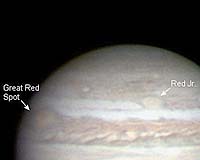
Washington DC (SPX) Mar 06, 2006 Backyard astronomers, grab your telescopes. Jupiter is growing a new red spot. Christopher Go of the Philippines photographed it on February 27th using an 11-inch telescope and a CCD camera: The official name of this storm is "Oval BA," but "Red Jr." might be better. It's about half the size of the famous Great Red Spot and almost exactly the same color. Oval BA first appeared in the year 2000 when three smaller spots collided and merged. Using Hubble and other telescopes, astronomers watched with great interest. A similar merger centuries ago may have created the original Great Red Spot, a storm twice as wide as our planet and at least 300 years old. At first, Oval BA remained white�the same color as the storms that combined to create it. But in recent months, things began to change: "The oval was white in November 2005, it slowly turned brown in December 2005, and red a few weeks ago," reports Go. "Now it is the same color as the Great Red Spot!" "Wow!" says Dr. Glenn Orton, an astronomer at JPL who specializes in studies of storms on Jupiter and other giant planets. "This is convincing. We've been monitoring Jupiter for years to see if Oval BA would turn red�and it finally seems to be happening." (Red Jr? Orton prefers "the not-so-Great Red Spot.") Why red? Curiously, no one knows precisely why the Great Red Spot itself is red. A favorite idea is that the storm dredges material from deep beneath Jupiter's cloudtops and lifts it to high altitudes where solar ultraviolet radiation--via some unknown chemical reaction�produces the familiar brick color. "The Great Red Spot is the most powerful storm on Jupiter, indeed, in the whole solar system," says Orton. The top of the storm rises 8 km above surrounding clouds. "It takes a powerful storm to lift material so high," he adds. Oval BA may have strengthened enough to do the same. Like the Great Red Spot, Red Jr. may be lifting material above the clouds where solar ultraviolet rays turn "chromophores" (color-changing compounds) red. If so, the deepening red is a sign that the storm is intensifying. "Some of Jupiter's white ovals have appeared slightly reddish before, for example in late 1999, but not often and not for long," says Dr. John Rogers, author of the book "Jupiter: The Giant Planet," which recounts telescopic observations of Jupiter for the last 100+ years. "It will indeed be interesting to see if Oval BA becomes permanently red." See for yourself: Jupiter is easy to find in the dawn sky. Step outside before sunrise, look south and up: sky map. Jupiter outshines everything around it. Small telescopes have no trouble making out Jupiter's cloudbelts and its four largest moons. Telescopes 10-inches or larger with CCD cameras should be able to track Red Jr. with ease. What's next? Will Red Jr. remain red? Will it grow or subside? Stay tuned for updates. Related Links The Red Spot at NASA  Flow Of High-Pressure Form Of Ice Tells Tales Of Interiors Of Giant Icy Moons
 Livermore CA (SPX) Mar 07, 2006
Everyday ice used to chill that glass of lemonade has helped researchers better understand the internal structure of icy moons in the far reaches of the solar system. A research team has demonstrated a new kind of "creep" or flow in a high-pressure form of ice by creating in a laboratory the conditions of pressure, temperature, stress, and grain size that mimic those in the deep interiors of large icy moons. |
|
|

| The content herein, unless otherwise known to be public domain, are Copyright 1995-2006 - SpaceDaily.AFP and UPI Wire Stories are copyright Agence France-Presse and United Press International. ESA PortalReports are copyright European Space Agency. All NASA sourced material is public domain. Additionalcopyrights may apply in whole or part to other bona fide parties. Advertising does not imply endorsement,agreement or approval of any opinions, statements or information provided by SpaceDaily on any Web page published or hosted by SpaceDaily. Privacy Statement |