|
 |
 |
 |
 |
 |
 |
 |
 |
 |

| . |  |
. |
New Sunspot Is Harbinger Of New Solar Cycle, Increasing Risk For Electrical Systems
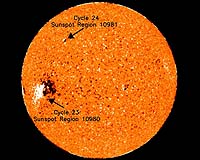
Washington DC (SPX) Jan 07, 2008 A new 11-year cycle of heightened solar activity, bringing with it increased risks for power grids, critical military, civilian and airline communications, GPS signals and even cell phones and ATM transactions, showed signs it was on its way late yesterday when the cycle's first sunspot appeared in the sun's Northern Hemisphere, NOAA scientists said. "This sunspot is like the first robin of spring," said solar physicist Douglas Biesecker of NOAA's Space Weather Prediction Center. "In this case, it's an early omen of solar storms that will gradually increase over the next few years." A sunspot is an area of highly organized magnetic activity on the surface of the sun. The new 11-year cycle, called Solar Cycle 24, is expected to build gradually, with the number of sunspots and solar storms reaching a maximum by 2011 or 2012, though devastating storms can occur at any time. During a solar storm, highly charged material ejected from the sun may head toward Earth, where it can bring down power grids, disrupt critical communications, and threaten astronauts with harmful radiation. Storms can also knock out commercial communications satellites and swamp Global Positioning System signals. Routine activities such as talking on a cell phone or getting money from an ATM machine could suddenly halt over a large part of the globe. "Our growing dependence on highly sophisticated, space-based technologies means we are far more vulnerable to space weather today than in the past," said Vice Admiral Conrad C. Lautenbacher, Jr., under secretary of commerce for oceans and atmosphere and NOAA administrator. "NOAA's space weather monitoring and forecasts are critical for the nation's ability to function smoothly during solar disturbances." Last April, in coordination with an international panel of solar experts, NOAA issued a forecast that Solar Cycle 24 would start in March 2008, plus or minus six months. The panel was evenly split between those predicting a strong or weak cycle. Both camps agree that the sooner the new cycle takes over the waning previous cycle, the more likely that it will be a strong season with many sunspots and major storms, said Biesecker. Many more sunspots with Solar Cycle 24 traits must emerge before scientists consider the new cycle dominant, with the potential for more frequent storms. The new sunspot, identified as #10,981, is the latest visible spot to appear since NOAA began numbering them on January 5, 1972. Its high-latitude location at 27 degrees North, and its negative polarity leading to the right in the Northern Hemisphere are clear-cut signs of a new solar cycle, according to NOAA experts. The first active regions and sunspots of a new solar cycle can emerge at high latitudes while those from the previous cycle continue to form closer to the equator. SWPC is the nation's first alert for solar activity and its affects on Earth. The center's space weather forecasters issue outlooks for the next 11-year solar "season" and warn of individual storms occurring on the sun that could impact Earth. SWPC is one of NOAA's nine National Centers for Environmental Prediction and is also the warning agency of the International Space Environment Service (ISES), a consortium of 11 member nations. Community Email This Article Comment On This Article Related Links NOAA Solar Science News at SpaceDaily
 Looking Back And Looking Forward
 Paris, France (ESA) Jan 03, 2008
2007 has been another year of scientific discovery. Every one of the science missions in operation has produced new results in many fields of astronomy. The International Heliophysical Year has been marked by a number of science observations from ESA's fleet of Sun monitoring spacecraft. Alongside the serendipitous observation of a new periodic comet, SOHO observations of coronal mass ejections have revealed radio pulses which can give warning of high intensity solar storms. |
|
|

| The content herein, unless otherwise known to be public domain, are Copyright 1995-2007 - SpaceDaily.AFP and UPI Wire Stories are copyright Agence France-Presse and United Press International. ESA Portal Reports are copyright European Space Agency. All NASA sourced material is public domain. Additional copyrights may apply in whole or part to other bona fide parties. Advertising does not imply endorsement,agreement or approval of any opinions, statements or information provided by SpaceDaily on any Web page published or hosted by SpaceDaily. Privacy Statement |