|
 |
 |
 |
 |
 |
 |
 |

| . |  |
. |

|
|
. |

 by Staff Writers Aalto, Finland (SPX) Sep 23, 2011
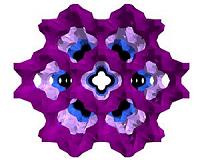
New hybrid carbon material, which combines both graphene and SWNTs, Graphene Nanoribbons encapsulated into Single-Walled Carbon Nanotubes have been discovered by researchers from Aalto University (Finland) and Umea University. Carbon nanotubes and graphene materials have attracted enormous interest from a broad range of specialists. We came up with the idea to create a novel hybrid material, which combines two most fascinating carbon nanomaterials - single-walled carbon nanotubes and graphene, says Doctor Albert Nasibulin from Aalto University. SWNTs have a hollow space inside, which was used in this study as an 1-dimensional chemical reactor. An intriguing property of this space is that chemical reactions occur differently compared to the bulk 3D conditions. Large polyaromatic hydrocarbon molecules (coronene and perylene), which can be imagined as small pieces of graphene, were used as building blocks to produce long and narrow graphene nanoribbons inside the nanotubes. It was found that the shape of encapsulated graphene nanoribbons can be modified by using different kinds of polyaromatic hydrocarbon molecules. Nanoribbons can be either metallic or semiconductor depending on their width and type. Interestingly, SWNTs can also be metallic, semiconducting (depending on their chirality) or insulating when chemically modified. This creates enormous potential for a wide range of applications: Now we can prepare GNR@SWNT in all possible combinations. For example, metallic nanoribbon inside insulating nanotube can be considered as the thinnest insulated nanowire. Nanoribbons can be used directly inside of SWNTs to generate light (e.g. as light emitting diodes), which will easily go through nanotubes and GNRs and by using of existing energy barrier will became a nano-lamp. Semiconducting nanoribbons can be used for transistor or solar cell applications. Metalli-metallic combination is in fact a new kind of coaxial nanocables (widely used as transmitters of radio signals) in nanosize since the nanoribbons are not connected with nanotubes due to hydrogen atoms, which occupy all the edges of nanoribbons. Precise control of the width and angle of the graphene nanoribbons will help assembly materials based on graphene with strict control of the band gap. Such control is not possible for a macroscopic graphene, obtained by traditional technology, says Dr. Ilya Anoshkin. The method of GNR@SWNT synthesis is very simple, easily scalable and allows to obtain almost 100% filling of tubes with nanoribbons. As it follows from theoretical results included in the paper, graphene nanoribbons should keep their unique properties inside of nanotubes while protected from environment by encapsulation and aligned within bundles of SWNTs. Related Links Aalto University Space Technology News - Applications and Research
|
. |
|
| The content herein, unless otherwise known to be public domain, are Copyright 1995-2011 - Space Media Network. AFP and UPI Wire Stories are copyright Agence France-Presse and United Press International. ESA Portal Reports are copyright European Space Agency. All NASA sourced material is public domain. Additional copyrights may apply in whole or part to other bona fide parties. Advertising does not imply endorsement,agreement or approval of any opinions, statements or information provided by Space Media Network on any Web page published or hosted by Space Media Network. Privacy Statement |

 del.icio.us
 Digg
Digg Reddit
 Google