. Military Space News .


.
STELLAR CHEMISTRY
New insights into the hidden galaxies of the universe
by Staff Writers
Copenhagen, Denmark (SPX) Jun 15, 2011

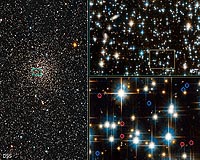
The galaxy ESO 546G-34 is small faint and unevolved low surface brightness galaxy of dwarf-type, which makes it somewhat similar to the Small Magellanic Cloud (companion galaxy to the Milky Way) in appearance. ESO 546G-34 has an extremely low abundance of heavier elements and contains at least 50 percent gas, which also makes it similar to the small galaxies that were abundant in the early universe.

A unique example of some of the lowest surface brightness galaxies in the universe have been found by an international team of astronomers lead by the Niels Bohr Institute. The galaxy has lower amounts of heavier elements than other known galaxies of this type. The discovery means that small low surface brightness galaxies may have more in common with the first galaxies formed shortly after the Big Bang than previously thought. The results have been published in Monthly Notices of the Royal Astronomical Society.

As the name implies, the galaxies are faint and therefore difficult to find and challenging to observe. The galaxy called ESO 546-G34 is a nearly 20 year old observation that no one had previously taken much notice of. The observation has now been analysed using new methods and it is only now that astronomers have realised how special it is.

"The galaxy gives us an idea of how the galaxies must have looked before star formation really got going", explains Lars Mattsson, an astrophysicist at the Dark Cosmology Centre at the Niels Bohr Institute, University of Copenhagen. The discovery was made in collaboration with astronomers at Uppsala University and the Astronomical Observatory in Kiev.

The evolution of galaxies
A galaxy consists of many millions or billions of stars. Stars are formed when giant gas clouds condense and form a ball of glowing gas - a star. A star produces energy through the fusion of hydrogen into helium, which fuses into carbon and oxygen and further into heavier and heavier elements. The process of conversion from gases to heavier elements takes anywhere from hundreds of thousands of years to billions of years.

Most of the known galaxies that have only formed small amounts of the heavy elements are young galaxies that are undergoing gigantic outbursts of star formation. This makes them incredibly bright and easier to observe. One type of galaxy with bursts of star formation is called blue compact galaxies, as newly formed stars emit a bluish light.

'Unevolved' dwarf galaxy
The galaxy that has been observed is small and contains only extremely small amounts of the heavier elements. That it consists mostly of the gases hydrogen and helium and is so faint means that it has only just begun to form stars.

"Our analysis shows that while a large, mature galaxy like our own galaxy, the Milky Way, is comprised of around 15-20 percent gas, this faint little galaxy is comprised of up to 50 percent gas and is very poor in heavier elements. This means that it is very unevolved", explains Lars Mattsson.

The theory is that the very small faint galaxies collide with each other and the greater concentration of gas material and dynamical disturbance boosts star formation and thereby form the larger blue, compact galaxies.

"ESO 546-G34 is a left over dwarf galaxy that doesn't seem to have collided with other galaxies. This gives us unique insight into how the earliest galaxies in the universe may have looked", explains Lars Mattsson.

Paper in ARXIV


Related Links
Dark Cosmology Centre
Stellar Chemistry, The Universe And All Within It

.
Get Our Free Newsletters Via Email
...
Buy Advertising Editorial Enquiries


. Comment on this article via your Facebook, Yahoo, AOL, Hotmail login.

Share this article via these popular social media networks
del.icio.usdel.icio.us DiggDigg RedditReddit GoogleGoogle


STELLAR CHEMISTRY
"Oddball" Star Cluster is a Hybrid
Baltimore MD (SPX) Jun 02, 2011
Scientists will tell you that the romantic idea is factually true: we are made of the same stuff as stars. In fact, all chemical elements heavier than helium are made in the stars, and research into how the universe became enriched in these "metals" is the focus of much current research in astronomy. Astronomers tend to call these elements "metals," though many are not metals in the usual sense. ... read more


STELLAR CHEMISTRY
NATO chief says missiles will not target Russia

Seoul deploys second Aegis destroyer

Russia says NATO not listening on missile shield

NATO chief rejects Russia's missile defence proposal

STELLAR CHEMISTRY
Iran 'speeds up missile development'

India tests nuclear-capable missile

MBDA Qualifies the New Naval Version of the Marte MK2 Missile

JAGM Tri-Mode Seeker Demonstrated Against Moving Sea Targets

STELLAR CHEMISTRY
Elbit sells UAVs in South America

US drones kill eight militants in Pakistan

Heron One achieves full operational capability in ISAF mission

Elbit to Supply a Latin-American Country with Hermes 900 UAS

STELLAR CHEMISTRY
Firebird Uses Three Eyes and Fourth Sensor Payload

New military radio unveiled

Indra To Supply Satellite Communications Systems To Brazil's MoD

Lockheed system proves its worth

STELLAR CHEMISTRY
Lockheed Martin F-35 Program Flight Test Update

LockMart Delivers Tactical Hardware for MEADS Intra-Fire Unit Communications

Boeing to build 10 C-17 airlifters for India

US Army Awards Lockheed Martin Contract for Precision Strike GMLRS Rockets

STELLAR CHEMISTRY
Australian forces receive 'very many' abuse claims

Gates: NATO spending decline 'serious problem'

Key US senators slam China on military parts probe

Saudis mount cleanup amid defense scandal

STELLAR CHEMISTRY
Outside View: Three deadly flaws

Leaders converge on Kazakhstan for security summit

NATO and the question of impotence

Commentary: Half pregnant strategy

STELLAR CHEMISTRY
Raytheon Acquires Directed Energy Capabilities of Ktech Corporation

MLD Test Moves Navy A Step Closer To Lasers For Ship Self-Defense

US Navy And Northrop Grumman Accomplish Goals For At-Sea Demonstration Of Maritime Laser


Memory Foam Mattress Review
Newsletters :: SpaceDaily Express :: SpaceWar Express :: TerraDaily Express :: Energy Daily
XML Feeds :: Space News :: Earth News :: War News :: Solar Energy News
.

The content herein, unless otherwise known to be public domain, are Copyright 1995-2011 - Space Media Network. AFP and UPI Wire Stories are copyright Agence France-Presse and United Press International. ESA Portal Reports are copyright European Space Agency. All NASA sourced material is public domain. Additional copyrights may apply in whole or part to other bona fide parties. Advertising does not imply endorsement,agreement or approval of any opinions, statements or information provided by Space Media Network on any Web page published or hosted by Space Media Network. Privacy Statement