|
 |
 |
 |
 |
 |
 |
 |

| . |  |
. |

|
|
. |

 by Oleg Nekhai for Voice of Russia Moscow (RIA Novosti) Sep 26, 2011
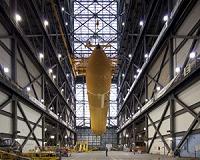
According to NASA administrator Charles Bolden, the U.S. will develop a new heavy-lift launch vehicle to send astronauts to an asteroid and to Mars. However, there is nothing revolutionary in the new project, says a Russian expert in space exploration. The new rocket called the Space Launch System will deliver from 70 to 100 tons of cargo, including the Orion Multi-Purpose Crew Vehicle for transport of crew and cargo. NASA engineers and designers decided to return to the old and tested technology and use a liquid hydrogen and liquid oxygen propulsion system. This is a two-stage rocket. The rocket will use five solid rocket boosters on either side of its core for the initial development flights. The first stage consists of three engines taken from the Space Shuttle programme and two solid-fuel boosters. An upgraded booster from the Apollo programme will be used in the second stage. The new NASA project has nothing revolutionary and reminds of the saying that all new are the well-forgotten old, says Russian expert in space exploration, Victor Minenko. "There is nothing extraordinary in the NASA project. Judging by figures, this is a modernized old liquid fuel rocket technology. The Soviet Union used hydrogen and oxygen fuel in its "Energia" rocket to launch the "Buran" shuttle," says Victor Minenko. The "Energia" rocket launched the "Buran" space shuttle weighing 105 tons in 1987. However, at present, scientists and engineers are engaged in solving other problems. There is a need to solve the problem of assembling space complexes in orbit. To this end, cheaper rockets that can carry 30-40 tons are needed but not the heavy rockets to fly to Mars. In fact, the use of hydrogen sharply increases the size of the rocket owing to low specific gravity of fuel, says Victor Minenko. "A mission to Mars will be carried out in a complex weighing 500-800 tons. It consists of several blocks, including the living module, which is comparable to the size of the International Space Station. The landing vehicle will weigh 80 tons and the rocket that will fly from Mars will weigh 25 tons. This is a very expensive expedition that can be compared to the cost of the ISS," Victor Minenko said. NASA plans to carry out a mission to Mars in the 2030s. However, the Russian expert is less optimistic and says that this will happen no earlier than the middle of the century. He believes the optimism of Americans is based on pragmatic considerations. They simply need to launch new ideas time and again to draw the attention of others. In short, they want to keep the fire burning.
Source: RIA Novosti Related Links - Rocket Science News at Space-Travel.Com
|
. |
|
| The content herein, unless otherwise known to be public domain, are Copyright 1995-2011 - Space Media Network. AFP and UPI Wire Stories are copyright Agence France-Presse and United Press International. ESA Portal Reports are copyright European Space Agency. All NASA sourced material is public domain. Additional copyrights may apply in whole or part to other bona fide parties. Advertising does not imply endorsement,agreement or approval of any opinions, statements or information provided by Space Media Network on any Web page published or hosted by Space Media Network. Privacy Statement |

 del.icio.us
 Digg
Digg Reddit
 Google