|
 |
 |
 |
 |
 |
 |
 |

| . |  |
. |

|
|
. |

 by Emil Venere West Lafayette, IN (SPX) Aug 26, 2011
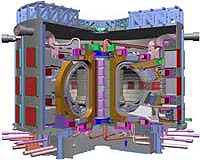
A new tool developed by nuclear engineers at Purdue University will be hitched to an experimental fusion reactor at Princeton University to learn precisely what happens when extremely hot plasmas touch and interact with the inner surface of the reactor. The work is aimed at understanding plasma-wall interactions to help develop coatings or materials capable of withstanding the grueling conditions inside fusion reactors, known as tokamaks. The machines house a magnetic field to confine a donut-shaped plasma of deuterium, an isotope of hydrogen. Fusion powers the stars and could lead to a limitless supply of clean energy. A fusion power plant would produce 10 times more energy than a conventional nuclear fission reactor, and because the deuterium fuel is contained in seawater, a fusion reactor's fuel supply would be virtually inexhaustible. "One of the biggest challenges for thermonuclear magnetic fusion is understanding how plasma in the fusion reactor modifies the inner wall," said Jean Paul Allain, an associate professor of nuclear engineering. "This is a big unknown because now we can't see what happens in real time to the wall surfaces." Purdue is working with researchers in the Princeton Plasma Physics Laboratory, which operates the nation's largest spherical tokamak reactor, known as the National Spherical Torus Experiment. The machines are ideal for materials testing. The materials analysis particle probe, or MAPP, will be connected to the underside of the tokamak. The students custom designed the probe to be small enough to fit under the reactor. "This was an engineering feat to fit a suite of instruments in a package only a few feet tall," Allain said. "It's a miniature materials characterization facility that will allow for a direct correlation between the plasma behavior and its interaction with an evolving wall material surface." A major challenge in finding the right coatings to line fusion reactors is that the material changes due to extreme conditions inside the reactors, where temperatures reach millions of degrees. Scientists have historically used "wall conditioning," or applying thin films of materials to induce changes to plasma behavior. "But it's been primarily an Edisonian approach," Allain said. "We don't know what mechanisms are primarily at work, and we need to if we are going to perfect fusion as an energy technology." The probe will provide information about how the coating materials evolve under plasma conditions and how the interaction correlates with changes in the plasma itself. Data from the instrument will help researchers develop innovative materials for the reactor vessel lining. "Currently we don't have the materials needed to sustain these large plasma and thermal fluxes," he said. "Some completely break down and melt. We need to understand how to operate and control the wall itself and the plasma together as they interacting." The effects of plasma on surface materials is now analyzed by removing test specimens from the lining after a year of running the reactor. Allain's group has worked with researchers at Purdue's Birck Nanotechnology Center to analyze tiles used in the Princeton tokamak. This approach shows only the cumulative results of hundreds of experiments, whereas scientists would prefer seeing the fine details associated with individual experiments. "That's what this new probe can do," he said. "It's a new type of surface-analysis diagnostic system designed to be integrated in a tokamak." The probe will allow scientists to study how specific materials interact with the plasma and yield data within minutes after completing an experiment. Data from the analyses would be used to validate computational models and guide design of new materials. The project is funded by the U.S. Department of Energy through the DOE's Office of Fusion Energy Sciences. The lead graduate student in the project is Bryan Heim, who has worked with Allain since he was a junior in undergraduate research. Additional students involved in the work are nuclear engineering students: doctoral students Zhangcan Yang and Chase Taylor, senior Sean Gonderman, junior Miguel Gonzalez, and seniors Sami Ortoleva and Eric Collins. Heim and Gonderman are spending six weeks at Princeton this summer to set up the instrument. Details of the MAPP system and its capabilities were presented recently during the 24th Symposium on Fusion Engineering in Chicago and the 38th International Conference on Plasma Science chaired by Purdue's School of Nuclear Engineering head Ahmed Hassanein. The work will be published in a special issue of the IEEE Transactions on Plasma Science next year. "The device is completely remote controlled, in principle from anywhere in the world," Allain said. Researchers might be able to access the instrument using nanoHUB.com, based at Purdue. "We will have a remote-control GUI software, and people will be able to use it online, working with a partner at Princeton," Allain said. "Therefore, someone from overseas will have the opportunity to use MAPP without leaving their home institution." The Materials Analysis Particle Probe (MAPP) Diagnostic System in NSTX Bryan Heim, S. Gonderman, C.N Taylor, J.P Allain, E. Yang, M. Gonzalez, E. Collins Purdue University C.H. Skinner, B. Ellis, W. Blanchard, L. Roquemore, H.W Kugel, R. Martin Princeton Plasma Physics Laboratory
|
. |
|
| The content herein, unless otherwise known to be public domain, are Copyright 1995-2011 - Space Media Network. AFP and UPI Wire Stories are copyright Agence France-Presse and United Press International. ESA Portal Reports are copyright European Space Agency. All NASA sourced material is public domain. Additional copyrights may apply in whole or part to other bona fide parties. Advertising does not imply endorsement,agreement or approval of any opinions, statements or information provided by Space Media Network on any Web page published or hosted by Space Media Network. Privacy Statement |

 del.icio.us
 Digg
Digg Reddit
 Google