
 |
 |
 |
 |
 |
 |
 |
 |
 |
 |

| . |  |
. |

Cambridge MA (SPX) Apr 11, 2011 A galaxy's core is a busy place, crowded with stars swarming around an enormous black hole. When galaxies collide, it gets even messier as the two black holes spiral toward each other, merging to make an even bigger gravitational monster. Once it is created, the monster goes on a rampage. The merger kicks the black hole into surrounding stars. There it finds a hearty meal, shredding and swallowing stars at a rapid clip. According to new research by Nick Stone and Avi Loeb (Harvard-Smithsonian Center for Astrophysics), upcoming sky surveys might offer astronomers a way to catch a gorging black hole "in the act." Before the merger, as the two black holes whirl around each other, they stir the galactic center like the blade of a blender. Their strong gravity warps space, sending out ripples known as gravitational waves. When the black holes merge, they emit gravitational waves more strongly in one direction. That inequality kicks the black hole in the opposite direction like a rocket engine. "That kick is very important. It can shove the black hole toward stars that otherwise would have been at a safe distance," said Stone. "Essentially, the black hole can go from starving to enjoying an all-you-can-eat buffet," he added. When tidal forces rip a star apart, its remains will spiral around the black hole, smashing and rubbing together, heating up enough to shine in the ultraviolet or X-rays. The black hole will glow as brightly as an exploding star, or supernova, before gradually fading in a distinctive way. Importantly, a wandering, supermassive black hole is expected to swallow many more stars than a black hole in an undisrupted galactic center. A stationary black hole disrupts one star every 100,000 years. In the best-case scenario, a wandering black hole could disrupt a star every decade. This would give astronomers a much better opportunity of spotting these events, particularly with new survey facilities like Pan-STARRS and the Large Synoptic Survey Telescope. Catching the signal from a disrupted star is a good start. However, astronomers really want to combine that information with gravitational wave data from the black hole merger. The Laser Interferometer Space Antenna (LISA), a future mission designed to detect and study gravitational waves, could provide that data. Gravitational wave measurements yield very accurate distances (to better than one part in a hundred, or 1 percent). However, they don't provide precise sky coordinates. A star's tidal disruption will let astronomers pinpoint the galaxy containing the recently merged black-hole binary. By correlating the galaxy's redshift (a change in its light that's caused by the expanding universe) with an accurate distance, astronomers can infer the equation of state of dark energy. In other words, they can learn more about the force that's accelerating cosmic expansion, and which dominates the cosmic mass/energy budget today. "Instead of 'standard candles' like supernovae, the black hole binary would be a 'standard siren.' Using it, we could create the most accurate cosmic 'ruler' possible," stated Loeb. Finding a merged black hole also would allow theorists to explore a new regime of Einstein's general theory of relativity. "We could test general relativity in the regime of strong gravity with unprecedented precision," said Loeb. Their work was published in the March 2011 issue of Monthly Notices of the Royal Astronomical Society. Headquartered in Cambridge, Mass., the Harvard-Smithsonian Center for Astrophysics (CfA) is a joint collaboration between the Smithsonian Astrophysical Observatory and the Harvard College Observatory. CfA scientists, organized into six research divisions, study the origin, evolution and ultimate fate of the universe.
Share This Article With Planet Earth
Related Links Harvard-Smithsonian Center for Astrophysics Understanding Time and Space

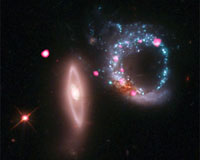 Giant Ring Of Black Holes
Huntsville AL (SPX) Feb 11, 2011 Just in time for Valentine's Day comes a new image of a ring - not of jewels, but of black holes. This composite image of Arp 147, a pair of interacting galaxies located about 430 million light-years from Earth, shows X-rays from the NASA's Chandra X-ray Observatory (pink) and optical data from the Hubble Space Telescope (red, green, blue) produced by the Space Telescope Science Institute (STScI ... read more |
|
|
| The content herein, unless otherwise known to be public domain, are Copyright 1995-2010 - SpaceDaily. AFP and UPI Wire Stories are copyright Agence France-Presse and United Press International. ESA Portal Reports are copyright European Space Agency. All NASA sourced material is public domain. Additional copyrights may apply in whole or part to other bona fide parties. Advertising does not imply endorsement,agreement or approval of any opinions, statements or information provided by SpaceDaily on any Web page published or hosted by SpaceDaily. Privacy Statement |


 del.icio.us
 Digg
Digg Reddit
 YahooMyWeb
 Google
 Facebook


