Eclipse will be proposed as a mission for NASA's series of Discovery missions, lower-cost, highly focused planetary science investigations designed to enhance our understanding of the solar system.
Eclipse will be proposed as a mission for NASA's series of Discovery missions, lower-cost, highly focused planetary science investigations designed to enhance our understanding of the solar system. |
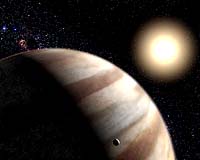
Eclipse is a proposed mission to perform the first sensitive imaging of nearby planetary systems using a high-contrast optical telescope and coronagraphic camera.
This three-year mission, proposed by Trauger, is intended to provide fundamental information on planetary systems around the Sun's nearest neighbors.
Eclipse will be proposed as a mission for NASA's series of Discovery missions, lower-cost, highly focused planetary science investigations designed to enhance our understanding of the solar system.
The technology and science derived from Eclipse could pave the way for NASA's future space science missions, such as Terrestrial Planet Finder.
"We're pleased to be partnering with Dr. Trauger and JPL on this important mission," said Greg Davidson, director of civil space for Northrop Grumman's Space Technology sector.
"Our experience building and integrating spacecraft for NASA's astronomical observatories, combined with JPL's success on Discovery missions, makes us a formidable team."
As the industry partner, Northrop Grumman will build the Eclipse spacecraft and integrate the payload. JPL will have overall project management responsibility.
As Principal Investigator, Trauger has the responsibility for defining the mission's scientific objectives and instrument payload and ensuring that mission objectives are met. Kodak will provide the 1.8-meter telescope.
NASA's Office of Space Science will select Discovery missions to begin formulation studies in early 2004, followed by the selection of one or more missions for flight. If selected, Eclipse is expected to be launched in 2009.
Related Links
 Farthest Known Planet Opens the Door For Finding New Earths
 Seattle - Jan 10, 2003
| The content herein, unless otherwise known to be public domain, are Copyright 1995-2006 - SpaceDaily.AFP and UPI Wire Stories are copyright Agence France-Presse and United Press International. ESA PortalReports are copyright European Space Agency. All NASA sourced material is public domain. Additionalcopyrights may apply in whole or part to other bona fide parties. Advertising does not imply endorsement,agreement or approval of any opinions, statements or information provided by SpaceDaily on any Web page published or hosted by SpaceDaily. Privacy Statement |