
 |
 |
 |
 |
 |
 |
 |
 |
 |
 |

| . |  |
. |

Houghton MI (SPX) Jul 23, 2010 From Tolkien's ring of power in The Lord of the Rings to Star Trek's Romulans, who could make their warships disappear from view, from Harry Potter's magical cloak to the garment that makes players vanish in the video game classic "Dungeons and Dragons, the power to turn someone or something invisible fascinates mankind. But who ever thought that a scientist at Michigan Technological University would be serious about building a working invisibility cloak? That's exactly what Elena Semouchkina, an associate professor of electrical and computer engineering at Michigan Tech, is doing. She has found ways to use magnetic resonance to capture rays of visible light and route them around objects, rendering those objects invisible to the human eye. Semouchkina and colleagues at the Pennsylvania State University, where she is also an adjunct professor, recently reported on their research in the journal Applied Physics Letters, published by the American Institute of Physics. Her co-authors were Douglas Werner and Carlo Pantano of Penn State and George Semouchkin, who works at Michigan Tech and Penn State. They describe developing a nonmetallic cloak that uses identical glass resonators made of chalcogenide glass, a type of dielectric material (one that does not conduct electricity). In computer simulations, the cloak made objects hit by infrared waves-approximately one micron or one-millionth of a meter long-disappear from view. Earlier attempts by other researchers used metal rings and wires. "Ours is the first to do the cloaking of cylindrical objects with glass," Semouchkina said. Her invisibility cloak uses metamaterials, which are artificial materials having properties that do not exist in nature, made of tiny glass resonators arranged in a concentric pattern in the shape of a cylinder. The "spokes" of the concentric configuration produce the magnetic resonance required to bend light waves around an object, making it invisible. Metamaterials, which huse small resonators instead of atoms or molecules of natural materials, straddle the boundary between materials science and electrical engineering. They were named one of the top three physics discoveries of the decade by the American Physical Society. A new researcher specializing in metamaterials is joining Michigan Tech's faculty this fall. Semouchkina and her team now are testing an invisibility cloak rescaled to work at mocrowave frequencies and made of ceramic resonators. They're using Michigan Tech's anechoic chamber, a cave-like compartment in an Electrical Energy Resources Center lab, lined with highly absorbent charcoal-gray foam cones. There, antennas transmit and receive microwaves, which are much longer than infrared light, up to several centimeters long. They have cloaked metal cylinders two to three inches in diameter and three to four inches high. "Starting from these experiments, we want to move to higher frequencies and smaller wavelengths," the researcher said. "The most exciting applications will be at the frequencies of visible light." So one day, could the police cloak a swat team or the Army, a tank? "It is possible in principle, but not at this time," Semouchkina said.
Share This Article With Planet Earth
Related Links Michigan Technological University Understanding Time and Space

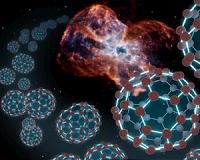 Elusive Buckyballs Found In Space For First Time
Pasadena CA (SPX) Jul 23, 2010 Astronomers using NASA's Spitzer Space Telescope have discovered carbon molecules, known as "buckyballs," in space for the first time. Buckyballs are soccer-ball-shaped molecules that were first observed in a laboratory 25 years ago. They are named for their resemblance to architect Buckminster Fuller's geodesic domes, which have interlocking circles on the surface of a partial sphere. Buc ... read more |
|
|
| The content herein, unless otherwise known to be public domain, are Copyright 1995-2010 - SpaceDaily. AFP and UPI Wire Stories are copyright Agence France-Presse and United Press International. ESA Portal Reports are copyright European Space Agency. All NASA sourced material is public domain. Additional copyrights may apply in whole or part to other bona fide parties. Advertising does not imply endorsement,agreement or approval of any opinions, statements or information provided by SpaceDaily on any Web page published or hosted by SpaceDaily. Privacy Statement |


 del.icio.us
 Digg
Digg Reddit
 YahooMyWeb
 Google
 Facebook


