|
 |
 |
 |
 |
 |
 |
 |
 |
 |

| . |  |
. |
Off-Center Optimism for a Planet
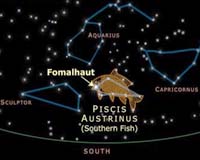
Moffett Field CA (SPX) Jun 24, 2005 A dust ring around the bright star Fomalhaut shows evidence of an orbiting planet, scientists report in the journal Nature today. The Hubble Space Telescope's Advanced Camera for Surveys was used to make visible light images of the dust ring. Previous observations made in infrared had detected the dust ring, but the visible light images are more detailed, showing a dust ring that does not encircle the star like a bulls-eye, but is off-center by about 15 AU (1 AU is the distance between the Earth and the sun). The scientists say that this off-kilter ring suggests a planet is in an elliptical orbit around the star, influencing the ring's shape. "You could compare Fomalhaut's belt to the images from the Cassini mission, that show how the rings of Saturn are shepherded by small moons that are also in orbit around Saturn," says Paul Kalas of the University of California, Berkeley, lead author of the Nature paper. Dust rings surrounding stars of a certain age are thought to be made by comet and asteroid collisions. Our own solar system has a similar ring called the Kuiper Belt, but it is estimated to have a thousand times less material than Fomalhaut's ring. "In some ways, the Fomalhaut system is a bit like our own," says Jane Greaves of the School of Physics and Astronomy at the University of St Andrews in Scotland. "For example, the team have found that the dust is lying in a very flat ring, which is the way our comets lie in our own Kuiper Belt. But the whole thing we see around Fomalhaut is on a much grander scale. And what's so striking is that the inner edge of this dust ring is so sharp - that really is very strong evidence that the inner edge is just being trimmed off, like with scissors, by an orbiting planet." Our Kuiper Belt lies about 30 to 50 AU from the sun. The inner edge of the Kuiper Belt is sharp due to Neptune's orbit at about 30 AU. Kalas says that Neptune knocks against the dust directly, pushing it back away from the sun. But in the case of Fomalhaut, Kalas says the planet acts as a brake rather than a barrier, slowing the rate of dust falling in towards the star. "You have material flowing in towards the star, but it encounters a resonance with a planet that's much closer in," says Kalas. "So the material gets delayed in its journey towards the star. And as it gets delayed, it's essentially just like a traffic jam on the highway, you see an over-density of dust." While the dust ring lies about 133 to 158 AU from the star, they believe the planet is much closer in, orbiting somewhere between 50 to 70 AU. This places the planet far outside the star's habitable zone - the region where water could remain as a liquid on a planet's surface. Kalas says he has calculated the habitable zone of Fomalhaut to be between 5 to 10 AU. The habitable zone in our solar system is about .95 to 1.37 AU, or roughly between the orbits of Venus and Mars. Fomalhaut's habitable zone is farther out because it is an A-class star, much brighter and hotter than our sun, a G-class star. They estimate the planet orbiting Fomalhaut could be 5 times the mass of Jupiter or smaller. Fomalhaut is about 200 million years old, and if the history of our solar system is typical, planets would still be in the process of forming around such a young star. These young planets would be hot glowing embers, and detectable by infrared or by visible light shifted to the red portion of the spectrum. Hubble should have been able to see any planet greater than 5 Jupiter masses orbiting between 50 to 100 AU. While they only detected 1.4 lunar masses worth of material in Fomalhaut's dust disk, the scientists estimate it could contain as much as 50 to 100 Earth masses. They base this estimate on the idea that such belts should contain larger objects than the sand-grain-sized dust they detected. "The Kuiper Belt objects appear as little point sources in the sky moving in reference to the background stars," says Kalas. "The dust is almost too faint to be seen in our Kuiper Belt. But it should be there, because these Kuiper Belt objects collide, and theorists produce simulations of our Kuiper Belt that show dust must be produced. Ironically, what we see around Fomalhaut is the dust and not the parent objects." Both the Kuiper Belt and Fomalhaut's disk reflect 10 percent of light that's incident on it, so presumably they have similar compositions. Astronomers say that such disks are common around A-class stars; more than half of them may have dusty rings. Vega, a hotter and more massive A-class star than Fomalhaut, has a dust disk, and the scientists say there is some evidence that Vega also may have a planet shepherding that dust around. While there is plenty of raw material in Fomalhaut's ring to construct planets, we know very little about the planetary systems of A-class stars. Kalas says there are no radial velocity planet searches for these types of stars because they have a featureless spectrum. Dust disks are less common around G-class stars like our sun, only about 1 in 10 are thought to have them. Presumably, the older the star is, the less apt it is to harbor a dusty disk. "When we look at very old stars, we tend to find dust less often," says Greaves. "But there are examples like Tau Ceti, which is almost a twin to the sun apart from being twice as old, it still has 10 times more orbiting comets than our sun does. This has really overthrown our idea that dust goes away and then planets sit there happily and life evolves." Life on Earth is believed to have begun more than 800 million years after the formation of the sun and the planets, prevented from flourishing earlier due to the period of heavy asteroid bombardment. A-class stars like Fomalhaut only live for about 713 million years, so if a planet does orbit that star, life would have a relatively short time to develop before the star turns into a red giant. "But we don't really know," says Greaves. "Maybe life could take a different path in this different environment." Related Links SpaceDaily Search SpaceDaily Subscribe To SpaceDaily Express  In Search Of An Elusive Earth Beyond Our Own
 Moffett Field CA (SPX) Jun 23, 2005
Geoff Marcy, professor of astronomy at the University of California, Berkeley, and director of the Center for integrative Planetary Science, leads a team of planet-hunters credited with the discovery of more than 100 planets that orbit nearby stars. |
|
|

| The content herein, unless otherwise known to be public domain, are Copyright 1995-2006 - SpaceDaily.AFP and UPI Wire Stories are copyright Agence France-Presse and United Press International. ESA PortalReports are copyright European Space Agency. All NASA sourced material is public domain. Additionalcopyrights may apply in whole or part to other bona fide parties. Advertising does not imply endorsement,agreement or approval of any opinions, statements or information provided by SpaceDaily on any Web page published or hosted by SpaceDaily. Privacy Statement |