|
 |
 |
 |
 |
 |
 |
 |
 |
 |

| . |  |
. |
Old Solar Cycle Returns
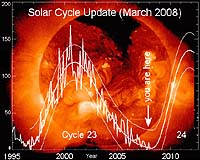
Huntsville AL (SPX) Mar 31, 2008 Solar Cycle 23, how can we miss you if you won't go away? Barely three months after forecasters announced the beginning of new Solar Cycle 24, old Solar Cycle 23 has returned. (Actually, it never left. Read on.) "This week, three big sunspots appeared and they are all old cycle spots," says NASA solar physicist David Hathaway. "We know this because of their magnetic polarity." What's going on? Hathaway explains: "We have two solar cycles in progress at the same time. Solar Cycle 24 has begun (the first new-cycle spot appeared in January 2008), but Solar Cycle 23 has not ended." Strange as it sounds, this is perfectly normal. Around the time of solar minimum--i.e., now--old-cycle spots and new-cycle spots frequently intermingle. Eventually Cycle 23 will fade to zero, giving way in full to Solar Cycle 24, but not yet. Meanwhile, on March 25th, sunspot 989, the smallest of the three sunspots, unleashed an M2-class solar flare. Flares are measured on a "Richter scale" ranging from A-class (puny) to X-class (powerful). M-class flares are of medium intensity. This one hurled a coronal mass ejection or "CME" into space, but the billion-ton cloud missed Earth. While the CME was still plowing through the sun's atmosphere, amateur radio astronomer Thomas Ashcraft heard "a heaving sound" coming from the loudspeaker of his 21 MHz shortwave receiver in New Mexico: listen. It was a Type II solar radio burst generated by shock waves at the leading edge of the CME. A thousand miles away in Virginia, David Thomas recorded the same emissions on a chart recorder he connected to his 20 MHz ham rig: look. "What a pleasant surprise," says Thomas. We could get more of this kind of activity in the next 7 to 10 days. It will take about that long for the sunspots to cross the face of the sun. The sun's rotation is turning the spots toward Earth, which means the next CME, if there is one, might not miss. CME strikes do no physical harm to Earth but they can cause Northern Lights, satellite glitches and, in extreme cases, power outages. The real significance of these spots is what they say about the solar cycle, says Hathaway. "Solar Cycle 24 has begun, but we won't be through solar minimum until the number of Cycle 24 spots rises above the declining number of Cycle 23 spots." Based on this latest spate of "old" activity, he thinks the next Solar Max probably won't arrive until 2012. Community Email This Article Comment On This Article Related Links SOHO The Sunspot Cycle Solar Science News at SpaceDaily
 Solar Corona Is Both Hot And Kinky
 Warwick UK (SPX) Mar 09, 2008
Astrophysicists are having a heated debate over the wave structure of the Sun's Corona - a debate which may one day influence solar weather forecasting and the theory behind fusion reactors. |
|
|

| The content herein, unless otherwise known to be public domain, are Copyright 1995-2007 - SpaceDaily.AFP and UPI Wire Stories are copyright Agence France-Presse and United Press International. ESA Portal Reports are copyright European Space Agency. All NASA sourced material is public domain. Additional copyrights may apply in whole or part to other bona fide parties. Advertising does not imply endorsement,agreement or approval of any opinions, statements or information provided by SpaceDaily on any Web page published or hosted by SpaceDaily. Privacy Statement |