
 |
 |
 |
 |
 |
 |
 |
 |
 |
 |

| . |  |
. |
One Step Closer To Finding The Higgs Boson
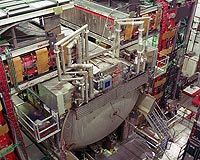
Bloomington IN (SPX) Mar 17, 2009 Six Indiana University physicists collaborating with researchers from around the world have helped move mankind one step closer to finding the Higgs boson, the still unidentified particle predicted by the Standard Model to be the origin of mass for all elementary particles. Former graduate student Leah Welty-Rieger, post-doctoral fellow Nirmalya Parua, research scientist Daria Zieminska, assistant professor Sabine Lammers, associate professor Harold Evans and Physics Department Chair Rick Van Kooten, with scientists from 80 other institutions working as part of the DZero collaboration, say they have observed particle collisions that produce single top quarks. The work was submitted March 4 to Physical Review Letters for publication. "Discovering single top quark production presents challenges similar to the Higgs boson search in the need to extract an extremely small signal from a very large background," Van Kooten explained. "And the techniques mastered for single top quark discovery are now being used for the Higgs boson search." "In particular, Lammers works on an analysis with essentially the same background to this single top quark channel and tunes simulations to get good agreement between data and background simulation," he added. "Her analysis will then be extended for application to data from the Large Hadron Collider to search for the Higgs boson using the ATLAS detector." The work was conducted by scientists in two collaborative teams at the Department of Energy's Fermi National Accelerator near Chicago using the Tevatron, the world's highest-energy particle collider now operating, to send protons through a magnetic course and then smash them into one another at high energies. Previously, top quarks had only been observed in pairs when produced by the strong nuclear interaction between tiny elementary particles. The production of single top quarks, which involves the weak nuclear force and is harder to identify experimentally, is observed only once in every 20 billion proton-antiproton collisions. Making identification trickier is the fact that the signal of these rare occurrences is easily mimicked by other background processes that occur at much higher rates. "Observation of the single top quark production is an important milestone for the Tevatron program," said Dennis Kovar, Associate Director of the Office of Science for High Energy Physics at the U.S. Department of Energy. "Furthermore, the highly sensitive and successful analysis is an important step in the search for the Higgs." To make the single-top discovery, physicists of the Collider Detector at Fermilab and DZero collaborations spent years combing independently through the results of proton-antiproton collisions. Each team identified several thousand collisions that looked the way experimenters expect single top events to appear. Sophisticated statistical analysis and detailed background modeling showed that a few hundred collision events produced the real thing. The two collaborations earlier had reported preliminary results on the search for the single top. Since then, experimenters have more than doubled the amount of data analyzed, and sharpened selection and analysis techniques, making the discovery possible. For each experiment, the probability that background events have faked the signal is now only one in nearly four million, allowing both collaborations to claim a bona fide discovery that paves the way to more discoveries. Davis, who was the physical coordinator for the experiments that led to the original announcement in 2007 of the evidence for production of single top quarks and their first direct measurement, said that while Tevatron now stands a good chance of beating Europe's still-idle Large Hadron Collider to measuring the Higgs boson, the facility will still be needed to confirm the particle's properties. LHC, located at CERN, the European Organization for Nuclear Research near Geneva, is expected to be back on line in late 2009. "With the delays at LHC the chance that Fermilab could identify the Higgs boson first becomes greater," he said. "But to pin it down, to confirm the properties that Tevatron might observe, we will need LHC." Share This Article With Planet Earth
Related Links Indiana University Understanding Time and Space
 Ultracold Gas Mimics Ultrahot Plasma
 Durham NC (SPX) Feb 19, 2009
Several years after Duke University researchers announced spectacular behavior of a low density ultracold gas cloud, researchers at Brookhaven National Laboratory have observed strikingly similar properties in a very hot and dense plasma "fluid" created to simulate conditions when the universe was about one millionths of a second old. |
|
|

| The content herein, unless otherwise known to be public domain, are Copyright 1995-2007 - SpaceDaily.AFP and UPI Wire Stories are copyright Agence France-Presse and United Press International. ESA Portal Reports are copyright European Space Agency. All NASA sourced material is public domain. Additional copyrights may apply in whole or part to other bona fide parties. Advertising does not imply endorsement,agreement or approval of any opinions, statements or information provided by SpaceDaily on any Web page published or hosted by SpaceDaily. Privacy Statement |
 del.icio.us
 Digg
Digg Reddit
 YahooMyWeb
 Google
 Facebook