|
 |
 |
 |
 |
 |
 |
 |
 |
 |

| . |  |
. |
Ophthalmologists And Physicists Team Up To Design Bionic Eye
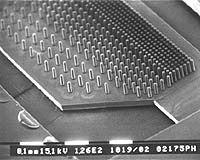
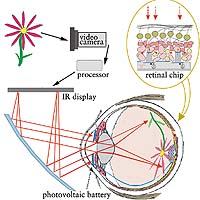
Stanford CA (SPX) Apr 05, 2005 Stanford physicists and eye doctors have teamed up to design a "bionic eye," of sorts. On Feb. 22 in the Journal of Neural Engineering, Daniel Palanker, Alexander Vankov and Phil Huie from the Department of Ophthalmology and the Hansen Experimental Physics Laboratory and Stephen Baccus from the Department of Neurobiology published a design of an optoelectronic retinal prosthesis system that can stimulate the retina with resolution corresponding to a visual acuity of 20/80 - sharp enough to orient yourself toward objects, recognize faces, read large fonts, watch TV and, perhaps most important, lead an independent life. The researchers hope their device may someday bring artificial vision to those blind due to retinal degeneration. They are testing their system in rats, but human trials are at least three years away. "This is basic research," said Palanker, a physicist whose primary appointment is in the Ophthalmology Department. "It's the essence of Bio-X," he said, referring to Stanford's interdisciplinary initiative to speed biomedical research from benchtop to bedside. The project is funded in part by the U.S. Air Force and VISX, which licensed the technology through Stanford's Office of Technology Licensing. Harvey Fishman, who is not an author of the current paper but directs the Stanford Ophthalmic Tissue Engineering Laboratory, pioneered the project. Degenerative retinal diseases result in death of photoreceptors-rod-shaped cells at the retina's periphery responsible for night vision and cone-shaped cells at its center responsible for color vision. Worldwide, 1.5 million people suffer from retinitis pigmentosa (RP), the leading cause of inherited blindness. In the Western world, age-related macular degeneration (AMD) is the major cause of vision loss in people over age 65, and the issue is becoming more critical as the population ages. Each year, 700,000 people are diagnosed with AMD, with 10 percent becoming legally blind, defined by 20/400 vision. Many AMD patients retain some degree of peripheral vision. "Currently, there is no effective treatment for most patients with AMD and RP," the researchers say in their paper. "However, if one could bypass the photoreceptors and directly stimulate the inner retina with visual signals, one might be able to restore some degree of sight." To that end, the researchers plan to directly stimulate the layer underneath the dead photoreceptors using a system that looks like a cousin of the high-tech visor blind engineer Lt. Geordi La Forge wore in Star Trek: The Next Generation. It consists of a tiny video camera mounted on transparent "virtual reality" style goggles. There's also a wallet-sized computer processor, a solar-powered battery implanted in the iris and a light-sensing chip implanted in the retina. The chip is the size of half a rice grain- 3 millimeters - and allows users to perceive 10 degrees of visual field at a time. It's a flat rectangle of plastic (eventually a silicon version will be developed) with one corner snipped off to create asymmetry so surgeons can orient it properly during implantation. One design includes an orchard of pillars: One side of each pillar is a light-sensing pixel and the other side is a cell-stimulating electrode. Pillar density dictates image resolution, or visual acuity. The strip of orchard across the top third of the chip is densely planted. The strip in the middle is moderately dense, and the strip at the bottom is sparser still. Dense electrodes lead to better image resolution but may inhibit the desirable migration of retinal cells into voids near electrodes, so the different electrode densities of a current chip design allow the researchers to explore parameters and come up with a chip that performs optimally. Another design - pore electrodes - involves an array of cavities with stimulating electrodes located inside each of them. How does the system work when viewing, say, a flower? First, light from the flower enters the video camera. (Keep in mind that camera technology is already pretty good at adjusting contrast and other types of image enhancement.) The video camera then sends the image of the flower to the wallet-sized computer for complex processing. The processor then wirelessly sends its image of the flower to an infrared LED-LCD screen mounted on the goggles. The transparent goggles reflect an infrared image into the eye and onto the retinal chip. Just as a person with normal vision cannot see the infrared signal coming out of a TV remote control, this infrared flower image is also invisible to normal photoreceptors. But for those sporting retinal implants, the infrared flower electrically stimulates the implant's array of photodiodes. The result? They may not have to settle for merely smelling the roses.
Complex processing: The eyes have it The eye is a complex machine. It has more than 100 million photoreceptors. "If we compare it to modern digital cameras, for example, it will be 100 megapixels," Palanker said during an interview in the Hansen Experimental Physics Laboratory. "We buy cameras usually of three megapixels, maybe four." And if electronic cameras do a good job of image processing, the eye does a spectacular job, compressing information before sending it to the brain through the 1 million axons that make up the optic nerve. "We have a built-in processor in the eye," Palanker said. "Before it goes into the brain, the image is significantly processed." The bottom layer of photoreceptors is where rhodopsin - a protein pigment that converts light into an electrical signal - exists.

|