|
 |
 |
 |
 |
 |
 |
 |
 |
 |

| . |  |
. |
Opportunity Puts Hematite on Hold
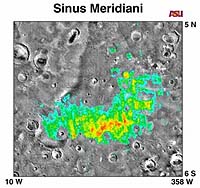
Pasadena - Feb 11, 2004 Scientists responsible for Opportunity's Mini-TES (miniature thermal emission spectrometer) have produced the first mineral map ever made from the surface of another planet. It depicts the concentration of hematite present in a small region of the floor of the crater that surrounds the rover. The map combines a black-and-white Pancam image with a false-color representation of Mini-TES data (see banner image). Different colors in the map correspond to different concentrations of hematite. Red and orange regions contain more hematite; green and blue areas contain little or none. The map shows that the hematite concentration is greatest in the top left of the image, and decreases toward both the bottom and the right. Hematite, an iron-bearing mineral, typically forms in the presence of water. By studying the distribution of hematite and determining what other minerals are found along with it, MER scientists hope to understand the role that water played in the history of Meridiani Planum. The detection of hematite from orbit is what initially interested planetary geologists in Meridiani as a landing site. Then, when Opportunity sent back its first images, the science team was handed a bonus: The rover had landed in a small crater that contained an outcrop of exposed bedrock. Unlike rocks or sand that have been transported an unknown distance by water or wind, bedrock by definition is found in the same location where it initially formed. That makes it ideal for pinning down the geologic history of a specific locale. But there's a hitch: The bedrock that has scientists so excited doesn't contain any hematite. So while they are anxious to study the outcrop, they will have to look elsewhere to figure out how the hematite got there. According to Phil Christensen, who heads the Mini-TES team, the hematite originates in a layer of dark material that sits atop the lighter-colored bedrock, "and that [darker] material is cascading or being transported down into the crater." "If you were there, with a shovel, I think you could dig down through that dark material and you would find dark bedrock up there," says Christensen. Unfortunately, Opportunity isn't equipped with a shovel. And although it can use one of its wheels to dig a trench - in fact, that is the plan for its next major activity - it is already sitting well below the dark bedrock layer that Christensen envisions. After the trenching operation is complete, says Steve Squyres, principle investigator for the MER mission, "we're going to head towards [the] outcrop. We're initially heading into stuff that is fairly hematite-poor, and then as we work from right to left, across the face of that outcrop, we're going to be moving into materials that are progressively more and more and more rich in hematite." But Christensen believes that Opportunity may have to climb up out of the crater and explore the surrounding plain to uncover the full history of hematite - and water - in Meridiani. "There has to be a dark bedrock unit up there somewhere," he says. "So when we get out of this crater and start driving across the plains, I'm hoping that somewhere, in a little patch, we'll see some of that dark bedrock. "I think that's going to be the material that has the hematite in it. And finding it in [bedrock] instead of [in] transported grains will help immensely in sorting out its origins." Related Links Mars Rovers at JPL Mars Rovers at Cornell SpaceDaily Search SpaceDaily Subscribe To SpaceDaily Express  Exploring Mars With Balloons
 Altadena - Feb 11, 2004
Balloons outfitted with innovative steering devices and robot probes may be the best way to perform detailed surveys of Mars in preparation for human exploration. Dr. Alexey Pankine, a project scientist at the Global Aerospace Corporation, presented an analysis of balloon applications for Mars exploration at the Space Technology and Applications International Forum in Albuquerque, NM on February 10, 2004. |
|
|

| The content herein, unless otherwise known to be public domain, are Copyright 1995-2006 - SpaceDaily.AFP and UPI Wire Stories are copyright Agence France-Presse and United Press International. ESA PortalReports are copyright European Space Agency. All NASA sourced material is public domain. Additionalcopyrights may apply in whole or part to other bona fide parties. Advertising does not imply endorsement,agreement or approval of any opinions, statements or information provided by SpaceDaily on any Web page published or hosted by SpaceDaily. Privacy Statement |