|
 |
 |
 |
 |
 |
 |
 |
 |
 |

| . |  |
. |
Outbound To The Outerplanets At 7 AU
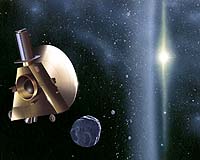
Principal Investigator New Horizons Washington DC (SPX) Aug 02, 2007 Since I last wrote here, in mid-June, New Horizons has continued its speedy journey from Jupiter's orbit (at 5.2 astronomical units) toward Saturn's at 9.5 AU. On average, we travel about a third of an astronomical unit each month, or roughly a million miles per day. So, as August begins, we're nearing the halfway point in the Jupiter-to-Saturn leg of our journey, set to reach 7 AU on Aug. 6. We'll pass Saturn's orbit (but not Saturn, which will be far away from our path) next June. During the six weeks since I last wrote, the spacecraft has primarily been in hibernation. In fact, since June 27, we've been in hibernation except for a brief, nine-day wakeup that began on July 12. The highlight of the mid-July wakeup period was the opening of the solar occultation port (SOCC) on the Alice UV spectrometer. This was the last of the seven instrument aperture doors we opened on New Horizons. Like the other openings, this one also went smoothly. Now, Alice can use its pinhole-sized SOCC aperture to stop down the intensity of sunlight by a factor of about 6,000, making it possible to trace the density and composition of Pluto's atmosphere versus altitude without blinding the detector. After opening the door, the spectrometer gathered its first-light SOCC spectrum by observing the B star Bellatrix. The Alice UV spectrometer also performed a series of self-tests and received a software update. Other activities during the July wakeup included onboard data-compression testing, some LORRI and SWAP instrument tests, and a data dump of the Venetia Burney Student Dust Counter's memory. New Horizons was returned to hibernation on July 21 and it will remain in hibernation until Aug. 16, when we wake it up for about three months of intensive onboard activities that include instrument calibrations and tests and a small course correction maneuver. Until then, we will "listen" to its telemetry or beacon tone broadcasts four times per week, but we won't be actively controlling the spacecraft -- all commands it executes were stored in onboard memory before entering this second hibernation period. While our spacecraft slumbers, our ground team is busy planning those activities for the wakeup period, which will stretch into mid-November. Simultaneously, our science team continues to analyze Jupiter data and work to select a final target distance for our Pluto closest approach. I'll have more to say about that next time I write. For now, however, I want to tell you that in early July the team completed a series of eight scientific papers about some of our most important Jupiter system results, and submitted those papers to the journal Science for publication this fall. Engineers are busy building a second New Horizons Operations Simulator (NHOPS II) that will serve as both an insurance policy against the failure of NHOPS I during the long flight to Pluto and the Kuiper Belt, and also as a "surge" simulator for times when NHOPS I is booked up. NHOPS II, replete with high-fidelity engineering models of the instrument payload and spacecraft subsystems, will be completed and then extensively checked out early next year. In other news, it is my pleasure to tell you that our project manager, Glen Fountain of the Applied Physics Laboratory, has been selected to receive the American Institute of Aeronautics and Astronautics (AIAA) 2007 von Braun Award for Excellence in Space Program Management. This award recognizes an individual for outstanding contributions in the management of a significant space or space-related program or project. I think Glen was an obvious choice, but I am biased, of course. Nonetheless, we're proud of him and look forward to Sept. 19, when he'll be presented with the award in conjunction with the AIAA Space Conference and Exhibit in Long Beach, Calif. Well, that's what I wanted to tell you about this time. I'll be back with more news in September. In the meantime, keep on exploring, just as we do. Community Email This Article Comment On This Article Related Links New Horizons at Pluto The million outer planets of a star called Sol
 Charon: An Ice Machine In The Ultimate Deep Freeze
 Tempe, AZ (SPX) Jul 18, 2007
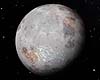
Frigid geysers spewing material up through cracks in the crust of Pluto's companion Charon and recoating parts of its surface in ice crystals could be making this distant world into the equivalent of an outer solar system ice machine. Evidence for these ice deposits comes from high-resolution spectra obtained using the Gemini Observatory's Adaptive Optics system, ALTAIR coupled with the near-infrared instrument NIRI. |
|
|

| The content herein, unless otherwise known to be public domain, are Copyright 1995-2006 - SpaceDaily.AFP and UPI Wire Stories are copyright Agence France-Presse and United Press International. ESA PortalReports are copyright European Space Agency. All NASA sourced material is public domain. Additionalcopyrights may apply in whole or part to other bona fide parties. Advertising does not imply endorsement,agreement or approval of any opinions, statements or information provided by SpaceDaily on any Web page published or hosted by SpaceDaily. Privacy Statement |