
 |
 |
 |
 |
 |
 |
 |
 |
 |
 |

| . |  |
. |

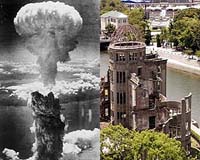
Washington (UPI) Aug 4, 2010 August marks the 65th anniversary of the atomic bombing of Japan. On Aug. 6, 1945, a B-29 named "Enola Gay" dropped "Little Boy," a nuclear device with the equivalent of 10-15 kilotons of TNT that destroyed Hiroshima. Three days later, after Japan's War Cabinet voted to continue the war, another B-29 launched "Fat Man" on Nagasaki. After the second attack, the War Cabinet was deadlocked and the emperor cast the deciding vote to end the war. Of the debate that swirled over the decision to use nuclear weapons in anger, perhaps the most interesting question was what forced Japan to surrender. After all, the military seemingly preferred death to surrender. Banzai attacks had become common place and kamikazes brought havoc to the U.S. Navy. Even Japanese civilians committed suicide on Guam and Saipan fearing American occupation. Japan had been totally blockaded by the U.S. military. Many Japanese were starving. Fire bombing attacks killed as many as 100,000 Japanese each in single nightlong raids over Tokyo, Nagoya and Haruna -- far more than would die under the two mushroom clouds. Yet the empire fought on knowing that it was losing or had lost the war. The actual decision in the White House to use the bombs took less than an hour. No one dissented. Japan started the war without warning. An invasion of Japan was estimated at upwards of 1 million allied casualties and millions of dead Japanese. Despite revisionist arguments that came much later, President Harry S. Truman had no choice. All that said, why did the Japanese War Cabinet deadlock allowing the emperor to end the war? The Japanese public and military leadership could understand how thousands of U.S. bombers could destroy Japanese cities. But few could comprehend how one plane armed with a single bomb could achieve equal levels of destruction. In essence, it was the combination of "shock and awe" on the collective Japanese psyche that changed a society that chose suicide over surrender or disgrace. From that distant point of origin, the doctrine of shock and awe would take shape some 50 years after Japan surrendered ending World War II. "Shock and awe" was developed by a small group of former senior military and defense officials (that included me as the inventor of the term) who were concerned that the United States was still basing its defense strategy too much on attrition warfare that won World War II but after the implosion of the Soviet Union needed new direction. The fundamental premise of shock and awe was to get an adversary to do what we wanted it to do or to stop doing what we deemed counter to our interests. Military force was a necessary, yet not always a sufficient, tool to achieve that outcome. Hence, shock and awe were directed at affecting, influencing and controlling the will and perception of an adversary. Unfortunately, the reference to Hiroshima and Nagasaki created the wrong impression that shock and awe could only be derived from use of weapons of mass destruction, something that decidedly wasn't the case. And in 2003 when the Second Gulf War kicked off in March, the term "shock and awe" received momentary stardom as the coalition raced to Baghdad. After the London Telegraph portrayed a full page color photo of a weapon exploding in Baghdad under the headline of "Baghdad Blitz," shock and awe sunk without trace. The question today, given the conflicts in Iraq and Afghanistan and against al-Qaida and suicide bombers as well as roadside bombs as weapons of choice, is whether shock and awe might be effective in dealing with jihadist or religious extremists whose perverted and twisted conception of Islam has turned them into 21st-century kamikazes. Is there any way that some combination of force meaning threat or use and other instruments from disinformation to deception and even more powerful forms of psychological warfare persuade, dissuade and even deter extremists from resorting to suicidal attacks? And what incentives might reinforce or magnify these efforts to affect, influence and control will and perception? Right now, the United States is spending well more than a trillion dollars to defend and protect itself from these enemies. We are also trying to harden and protect our infrastructure that will add over time more trillions of dollars to the bill. Yet, what are we doing to determine how such attacks and adversaries might be deterred or constrained in the first place? Some six years ago, the Pentagon's Defense Science Board concluded that the United States couldn't defeat its jihadist enemies unless it could win the war of ideas through a program of strategic communications. Unfortunately, that campaign isn't going well and we surely aren't winning the war of ideas against al-Qaida. Shock and awe doesn't guarantee an effective antidote. However, it may be time to dust the concept off and see if it applies. (Harlan Ullman is chairman of the Killowen Group, which advises leaders of government and business, and senior adviser at Washington's Atlantic Council.) (United Press International's "Outside View" commentaries are written by outside contributors who specialize in a variety of important issues. The views expressed do not necessarily reflect those of United Press International. In the interests of creating an open forum, original submissions are invited.)
Share This Article With Planet Earth
Related Links Learn about nuclear weapons doctrine and defense at SpaceWar.com Learn about missile defense at SpaceWar.com All about missiles at SpaceWar.com Learn about the Superpowers of the 21st Century at SpaceWar.com

 Horror of Hiroshima seared into survivors' minds
Hiroshima, Japan (AFP) Aug 4, 2010 Three days after an atomic bomb devastated Hiroshima, six-year-old Kazuko Uragashira and her parents were aboard an evacuation train out of their charred home city. Having narrowly survived the nuclear inferno, the family headed for the home of an uncle, not knowing that another date with destiny lay ahead of them. His home town was Nagasaki. Uragashira remembers sitting on the train, he ... read more |
|
|
| The content herein, unless otherwise known to be public domain, are Copyright 1995-2010 - SpaceDaily. AFP and UPI Wire Stories are copyright Agence France-Presse and United Press International. ESA Portal Reports are copyright European Space Agency. All NASA sourced material is public domain. Additional copyrights may apply in whole or part to other bona fide parties. Advertising does not imply endorsement,agreement or approval of any opinions, statements or information provided by SpaceDaily on any Web page published or hosted by SpaceDaily. Privacy Statement |


 del.icio.us
 Digg
Digg Reddit
 YahooMyWeb
 Google
 Facebook


