
 |
 |
 |
 |
 |
 |
 |
 |
 |
 |

| . |  |
. |

Honolulu HI (SPX) Feb 28, 2011 The Pan-STARRS PS1 telescope on Haleakala, Maui, discovered 19 near-Earth asteroids on the night of January 29, the most asteroids discovered by one telescope on a single night. "This record number of discoveries shows that PS1 is the world's most powerful telescope for this kind of study," said Nick Kaiser, head of the Pan-STARRS project. "NASA and the U.S. Air Force Research Laboratory's support of this project illustrates how seriously they are taking the threat from near-Earth asteroids." Pan-STARRS software engineer Larry Denneau spent that Saturday night in his University of Hawaii at Manoa office in Honolulu processing the PS1 data as it was transmitted from the telescope over the Internet. During the night and into the next afternoon, he and others came up with 30 possible new near-Earth asteroids. Asteroids are discovered because they appear to move against the background of stars. To confirm asteroid discoveries, scientists must carefully re-observe them several times within 12-72 hours to define their orbits, otherwise they are likely to be "lost." Denneau and colleagues quickly sent their discoveries to the Minor Planet Center in Cambridge, Mass., which collects and disseminates data about asteroids and comets, so that other astronomers can re-observe the objects. "Usually there are several mainland observatories that would help us confirm our discoveries, but widespread snowstorms there closed down many of them, so we had to scramble to confirm many of the discoveries ourselves," noted Institute for Astronomy astronomer Richard Wainscoat. Wainscoat, astronomer David Tholen, and graduate student Marco Micheli spent the next three nights searching for the asteroids using telescopes at Mauna Kea Observatories, Hawaii. On Sunday night, they confirmed that two of the asteroids were near-Earth asteroids before snow on Mauna Kea forced the telescopes to close. On Monday night, they confirmed nine more before fog set in. On Tuesday night, they searched for four, but found only one. After Tuesday, the remaining unconfirmed near-Earth asteroids had moved too far to be found again. Telescopes in Arizona, Illinois, Italy, Japan, Kansas, New Mexico, and the United Kingdom, and the Faulkes Telescope on Haleakala also helped to confirm seven of the discoveries. Two of the asteroids, it turns out, have orbits that come extremely close to Earth's. There is no immediate danger, but a collision in the next century or so, while unlikely, cannot yet be ruled out. Astronomers will be paying close attention to these objects.
Share This Article With Planet Earth
Related Links Minor Planet Center Asteroid and Comet Mission News, Science and Technology

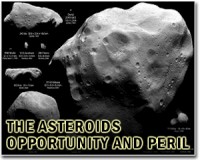 Record number of asteroids spotted
Honolulu (UPI) Feb 25, 2011 Astronomers using a telescope on the island of Maui in Hawaii said they discovered 19 near-Earth asteroids Jan. 29, the most ever found in a single night. Scientists at the Pan-STARRS PS1 telescope on Haleakala, Maui, said the record demonstration of the year-old telescope's capabilities was made possible by recent software improvements and refinements in observational techniques, the H ... read more |
|
|
| The content herein, unless otherwise known to be public domain, are Copyright 1995-2010 - SpaceDaily. AFP and UPI Wire Stories are copyright Agence France-Presse and United Press International. ESA Portal Reports are copyright European Space Agency. All NASA sourced material is public domain. Additional copyrights may apply in whole or part to other bona fide parties. Advertising does not imply endorsement,agreement or approval of any opinions, statements or information provided by SpaceDaily on any Web page published or hosted by SpaceDaily. Privacy Statement |


 del.icio.us
 Digg
Digg Reddit
 YahooMyWeb
 Google
 Facebook


