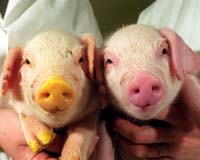
and this little piggy is a....
and this little piggy is a.... |
Panelists uniformly supported biotechnology and expressed hope for its potential. The biotechnology representatives expressed confidence in the efficacy of regulation by the U.S. Food and Drug Administration and self-regulation of biotechnology developers, but consumer interests and bioethicists said the regulations were not transparent enough for consumers to accept GM animals.
Carol Tucker Foreman, with the Consumer Federation of America, said there may be justification for permitting transgenic and cloned animals in the food supply, but public support of GM foods has fallen recently. She said FDA approval, which does not allow public participation, is not instilling consumer confidence and needs public review.
The current system fails, Foreman said.
John Phillips, one of the creators of EnviroPig, which excretes 50 percent less phosphorous than normal -- and thereby eases the potential for water pollution -- said FDA standards for reviewing GM animals thoroughly considers animals' well-being, safety to humans and environmental effects.
What we need in the regulatory system, I think by and large, already exists, he said.
All rights reserved. Copyright 2004 by United Press International. Sections of the information displayed on this page (dispatches, photographs, logos) are protected by intellectual property rights owned by United Press International. As a consequence, you may not copy, reproduce, modify, transmit, publish, display or in any way commercially exploit any of the content of this section without the prior written consent of by United Press International.
Related Links
 Future Neurotransmitter Chips For The Eye
 New York (UPI) Jun 29, 2004
| The content herein, unless otherwise known to be public domain, are Copyright 1995-2006 - SpaceDaily.AFP and UPI Wire Stories are copyright Agence France-Presse and United Press International. ESA PortalReports are copyright European Space Agency. All NASA sourced material is public domain. Additionalcopyrights may apply in whole or part to other bona fide parties. Advertising does not imply endorsement,agreement or approval of any opinions, statements or information provided by SpaceDaily on any Web page published or hosted by SpaceDaily. Privacy Statement |