
 |
 |
 |
 |
 |
 |
 |
 |
 |
 |

| . |  |
. |
Perfect 10 Image From Repaired Hubble Telescope
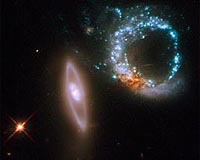
Baltimore MD (SPX) Oct 31, 2008 NASA's Hubble Space Telescope is back in business. Just a couple of days after the orbiting observatory was brought back online, Hubble aimed its prime working camera, the Wide Field Planetary Camera 2 (WFPC2), at a particularly intriguing target, a pair of gravitationally interacting galaxies called Arp 147. The image demonstrated that the camera is working exactly as it was before going offline, thereby scoring a "perfect 10" both for performance and beauty. The two galaxies happen to be oriented so that they appear to mark the number 10. The left-most galaxy, or the "one" in this image, is relatively undisturbed apart from a smooth ring of starlight. It appears nearly on edge to our line of sight. The right-most galaxy, resembling a zero, exhibits a clumpy, blue ring of intense star formation. The blue ring was most probably formed after the galaxy on the left passed through the galaxy on the right. Just as a pebble thrown into a pond creates an outwardly moving circular wave, a propagating density wave was generated at the point of impact and spread outward. As this density wave collided with material in the target galaxy that was moving inward due to the gravitational pull of the two galaxies, shocks and dense gas were produced, stimulating star formation. The dusty reddish knot at the lower left of the blue ring probably marks the location of the original nucleus of the galaxy that was hit. Arp 147 appears in the Arp Atlas of Peculiar Galaxies, compiled by Halton Arp in the 1960s and published in 1966. This picture was assembled from WFPC2 images taken with three separate filters. The blue, visible-light, and infrared filters are represented by the colors blue, green, and red, respectively. The galaxy pair was photographed on October 27-28, 2008. Arp 147 lies in the constellation Cetus, and it is more than 400 million light-years away from Earth. Community Email This Article Comment On This Article Share This Article With Planet Earth
Related Links Hubble Space Telescope Space Telescope News and Technology at Skynightly.com
 NASA Facing Make Or Break Decision For Hubble Future
 Washington (UPI) Oct 24, 2008
 U.S. space officials reactivated the Hubble space telescope's instrument panel Thursday in an effort to get the telescope transmitting again. |
|
|

| The content herein, unless otherwise known to be public domain, are Copyright 1995-2007 - SpaceDaily.AFP and UPI Wire Stories are copyright Agence France-Presse and United Press International. ESA Portal Reports are copyright European Space Agency. All NASA sourced material is public domain. Additional copyrights may apply in whole or part to other bona fide parties. Advertising does not imply endorsement,agreement or approval of any opinions, statements or information provided by SpaceDaily on any Web page published or hosted by SpaceDaily. Privacy Statement |
 del.icio.us
 Digg
Digg Reddit
 YahooMyWeb
 Google
 Facebook