
. Military Space News .
FARM NEWS
Pesticides used to help bees may actually harm them
by Staff Writers
Blacksburg VA (SPX) Aug 10, 2016


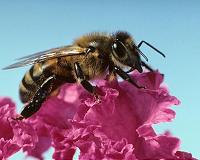
In general, honeybee health has been declining since the 1980s, with the introduction of new pathogens and pests. Image courtesy Rob Flynn. For a larger version of this image please go here.

Pesticides beekeepers are using to improve honeybee health may actually be harming the bees by damaging the bacteria communities in their guts, according to a team led by a Virginia Tech scientist.

The discovery, published in the journal Frontiers in Microbiology, is a concern because alterations can affect the gut's ability to metabolize sugars and peptides, processes that are vital for honeybee health. Beekeepers typically apply pesticides to hives to rid them of harmful parasites such as Varroa mites.

"Although helpful for ridding hives of parasites and pathogens, the chemicals in beekeeper-applied pesticides can be harmful to the bees," said Mark Williams, an associate professor of horticulture in the College of Agriculture and Life Sciences and lead author. "Our research suggests that pesticides could specifically impact the microbes that are crucial to honey bee nutrition and health."

For the project, the team extracted genomic data from honeybees that lived in hives that were treated with pesticides (three different kinds) and compared with those that were not. Samples were pulled from hives in three separate Blacksburg locations.

Honeybees from chlorothalanil-treated hives showed the greatest change in gut microbiome, said Williams, who is also affiliated with the Fralin Life Science Institute.

Looking ahead, the team plans to investigate the specific changes in gut microbiota activities that affect honeybee survival. Honeybees are the foundation of successful high-value food production.

"Our team wants to better describe the core microbiota using bioinformatics to help best characterize the microbes that support healthy honeybees and thus stave off disease naturally," said co-author Richard Rodrigues, a postdoctoral researcher at Oregon State University and formerly a graduate student in Williams' lab.

Other authors include Troy Anderson, a former assistant professor of entomology at Virginia Tech; Madhavi Kakumanu, a postdoctoral scientist at North Carolina State University and former Virginia Tech graduate student in Williams' lab; and Alison Reeves, a former graduate student in Anderson's lab.

In Virginia, the approximate rate of hive loss is more than 30 percent per year, and continued losses are expected to drive up the cost for important crops that bees make possible, such as apples, melon and squash.


Thanks for being here;
We need your help. The Space Media Network continues to grow but revenues have never been harder to maintain.

With the rise of Ad Blockers, and Facebook - our traditional revenue sources via quality network advertising continues to decline. And unlike so many other news sites, we don't have a paywall - with those annoying usernames and passwords.

Our news coverage takes time and effort to publish 365 days a year.

If you find our news sites informative and useful then please consider becoming a regular supporter or for now make a one off contribution.
SpaceMediaNetwork Contributor
$5 Billed Once


credit card or paypal
SpaceMediaNetwork Monthly Supporter
$5 Billed Monthly


paypal only


.


Related Links
Virginia Tech
Farming Today - Suppliers and Technology


Comment on this article via your Facebook, Yahoo, AOL, Hotmail login.

Share this article via these popular social media networks
del.icio.usdel.icio.us DiggDigg RedditReddit GoogleGoogle

Previous Report
FARM NEWS
Reinventing French fizz in face of climate change
Reims, France (AFP) Aug 4, 2016
France's Champagne country has little to celebrate as global warming threatens to wreak havoc on production, forcing winegrowers to take a sober look at their future. "We are taking a very long-term view," says Thibaut Le Mailloux of the Champagne Committee, a trade association of independent winegrowers and merchants. Climate change has already had an effect on the champagne production ... read more


FARM NEWS
Will Russia and China Build an SCO-Based Joint Missile Defense System

Raytheon gets $130 million missile defense contract modification

Russia Designing Blimps Aimed at Reducing Threat of US Cruise Missiles

Protests as S. Korea president defends US anti-missile system

FARM NEWS
Navy conducts first LCS Harpoon missile test

Lockheed demonstrates LRASM's surface launch capability

MBDA fires Brimstone missile from Apache helicopter

State Dept. approves $821 million SM-2 missile sale to Japan

FARM NEWS
160 Commercial Drone Companies to Showcase Latest UAV Technology at InterDrone

Donuts in flight in first US-approved drone delivery

Virtek's graphene-winged Prospero drone to take flight

Germany's U.N. peacekeepers to use Heron 1 drones

FARM NEWS
L-3 Communications gets $216 million U.S. Army aircraft contract modification

Raytheon developing next-gen airborne communications

Rethinking the Space Environment in a Globalized World

What Industry Can Teach the DoD About Innovation

FARM NEWS
BAE receives $245 million contract for Type 26 gun system

AM General gets $356 million to provide Humvees for Afghanistan

U.S. Air National Guard fires Lockheed laser-guided training rounds for first time

Lockheed Martin to provide counter-IED system for U.S. partner nations

FARM NEWS
Russia has $4.6B in military exports in 2016

Guns, not roses: Conflicts fire up Bulgaria arms trade

CAE gets $111 million in UAE defense contracts

Senators look to block U.S. sale of bombs to Saudis for bombing of Yemen

FARM NEWS
Trump's economic plan

China installs radar in disputed waters: Japanese media

Tremors from Turkey coup rattle US, EU

Turkey ruling party orders purge after coup attempt

FARM NEWS
New silicon structures could make better biointerfaces

Beating the heat a challenge at the nanoscale

Borrowing from pastry chefs, engineers create nanolayered composites

New nanoscale technologies could revolutionize microscopes, study of disease


The content herein, unless otherwise known to be public domain, are Copyright 1995-2024 - Space Media Network. All websites are published in Australia and are solely subject to Australian law and governed by Fair Use principals for news reporting and research purposes. AFP, UPI and IANS news wire stories are copyright Agence France-Presse, United Press International and Indo-Asia News Service. ESA news reports are copyright European Space Agency. All NASA sourced material is public domain. Additional copyrights may apply in whole or part to other bona fide parties. All articles labeled "by Staff Writers" include reports supplied to Space Media Network by industry news wires, PR agencies, corporate press officers and the like. Such articles are individually curated and edited by Space Media Network staff on the basis of the report's information value to our industry and professional readership. Advertising does not imply endorsement, agreement or approval of any opinions, statements or information provided by Space Media Network on any Web page published or hosted by Space Media Network. General Data Protection Regulation (GDPR) Statement Our advertisers use various cookies and the like to deliver the best ad banner available at one time. All network advertising suppliers have GDPR policies (Legitimate Interest) that conform with EU regulations for data collection. By using our websites you consent to cookie based advertising. If you do not agree with this then you must stop using the websites from May 25, 2018. Privacy Statement. Additional information can be found here at About Us.