. Military Space News .
Physicists closer to quantum computing

disclaimer: image is for illustration purposes only
by Staff Writers
Berkeley, Calif. (UPI) Oct 28, 2008
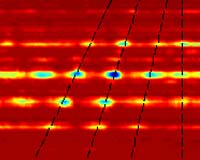
A team of U.S. and British physicists reports taking a step toward quantum computing by successfully using a single atomic nucleus as solid-state memory.

Researchers from the U.S. Department of Energy's Lawrence Berkeley National Laboratory, Oxford University and Princeton University said they precisely doped exceptionally pure and isotopically controlled crystals of silicon with phosphorus atoms. Quantum information was processed in the phosphorus electrons, transferred to the phosphorus nuclei and then subsequently transferred back to the electrons.

The scientists said that was the first demonstration that a single atomic nucleus can serve as quantum computational memory.

"In this exciting collaboration �� we have reported on a very important demonstration of coherent information transfer between the electron spin (processing qubit) and the nuclear spin (memory qubit) of phosphorus atoms in isotopically enriched silicon crystals," said study co-author Thomas Schenkel, a physicist in Berkeley Lab's Accelerator and Fusion Research Division.

"The electron spin information was faithfully stored in the nuclear spin for nearly two seconds (thousands of times longer than ever reported previously) and then transferred back to the electron spin with about 90-percent fidelity," Schenkel said.

The experiment is reported in the Oct. 23 issue of the journal Nature.

Community
Email This Article
Comment On This Article

Share This Article With Planet Earth
del.icio.usdel.icio.us DiggDigg RedditReddit
YahooMyWebYahooMyWeb GoogleGoogle FacebookFacebook


Related Links
Super Computer News and HPC Technology


Memory Foam Mattress Review
Newsletters :: SpaceDaily :: SpaceWar :: TerraDaily :: Energy Daily
XML Feeds :: Space News :: Earth News :: War News :: Solar Energy News


Voltaire Powers World's Most Powerful Supercomputer For NNSA's Los Alamos

Dresden, Germany (SPX) Jul 02, 2008
Voltaire has announced that the company's InfiniBand-based switches are powering the world's largest supercomputer for the National Nuclear Security Administration's (NNSA) Los Alamos National Laboratory.


  • Analysis: Germany can help next president
  • China's Wen leaves for Russia, Kazakhstan
  • Outside View: China's silent dominance
  • French minister opposes Georgia, Ukraine entry to NATO

  • Iran sets up new naval base near the Gulf
  • Gates calls for modernization of US nuclear arsenal
  • Bush Eyes Diplomatic Relations With Iran
  • NKorea threatens to suspend complex over leaflets

  • Taiwan to produce 300 cruise missiles: report
  • LockMart's JASSM-ER Successful In Latest Flight Test
  • US Navy Launches Raytheon Tomahawk Block IV From Submarine
  • Army And LM Support Second Successful International PAC-3 Missile Test

  • Keeping The Tu-95 Operational In The 21st Century
  • Aging Tu-95 Nuclear Missile Platform Offers New Strategic Threat
  • Outside View: Asian missile power
  • Key Flight Software Delivered For Missile Warning Satellite

  • New EU CO2 caps anger airlines
  • Energy Department has high school contest
  • Researchers Scientists Perform High Altitude Experiments
  • Airbus expecting 'large' China order by early 2009: CEO

  • Aurora Wins USAF Contract On Vision-Based MAV Guidance
  • Successful Live-Fire Testing Of Shadow TUAS
  • DCNS Achieves Automatic UAV Landing On Frigate
  • AAI Receives Contract For Additional Shadow TUAS

  • Feature: Balad, Iraqi city in transition
  • Feature: Mortar attacks fade in Iraq
  • Barzani says Iraq-US security pact dominates his talks with Rice
  • Pentagon on guard for White House wartime transition

  • Thompson Files: Don't cut back on tanks
  • New fighter jet hope for long-legged Dutch
  • LM F-35 Successfully Wraps Up Testing
  • Lasers May Aid Missile Defense, Engine Crack Detection

  • The content herein, unless otherwise known to be public domain, are Copyright 1995-2007 - SpaceDaily.AFP and UPI Wire Stories are copyright Agence France-Presse and United Press International. ESA Portal Reports are copyright European Space Agency. All NASA sourced material is public domain. Additional copyrights may apply in whole or part to other bona fide parties. Advertising does not imply endorsement,agreement or approval of any opinions, statements or information provided by SpaceDaily on any Web page published or hosted by SpaceDaily. Privacy Statement