|
 |
 |
 |
 |
 |
 |
 |
 |
 |

| . |  |
. |
Pierre Auger Observatory Shares Cosmic-Ray Data
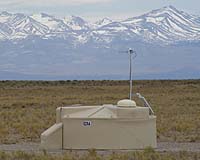
Malargue, Argentina (SPX) Jul 09, 2007 Scientists of the Pierre Auger Collaboration have begun the public release of one percent of the cosmic-ray events recorded by the Pierre Auger Observatory in Argentina. New cosmic-ray data-about 70 events per day-will be posted on a daily basis. The international Pierre Auger Collaboration, which includes scientists from 17 countries, explores the origins of extremely rare ultra-high-energy cosmic rays-particles from space that hit Earth, some with energies 100 million times higher than those made by the world's highest-energy particle accelerator, the Tevatron at Fermilab. These are the highest-energy particles ever recorded in nature. When such a particle hits the atmosphere it creates an air shower that can contain 200 billion particles by the time it reaches the ground. The one-percent release is part of the worldwide Pierre Auger education and outreach program. It will allow teachers to expose students to real scientific data and the breathtaking processes that take place in the cosmos, hurling charged particles toward Earth. The two Web sites provide the data both as graphical displays and in tabular form. For each cosmic-ray air shower, the Web sites show the energy and direction of the incoming cosmic-ray particle. The public data provides information on cosmic-rays with extremely high energy, up to 5 x 10^19 electron volts (eV). When construction is complete near the end of the year, the Pierre Auger Observatory will extend over 3000 square kilometers (~1000 square miles) in Argentina's Mendoza Province, just east of the Andes Mountains. The full observatory will consist of an array of 1,600 detectors that record the arrival of air showers on the ground. Information gathered by the detectors is transmitted to a central data acquisition system using solar-powered cellular phone technology. Surrounding the detector array and looking toward its center is a set of 24 telescopes that-on clear moonless nights-observe the ultraviolet fluorescence light produced as shower particles travel through the atmosphere. The Pierre Auger collaboration includes more than 370 scientists and engineers from 60 institutions in 17 countries, which share the construction cost of approximately $50 million (US). The international funding agencies contributing to the Pierre Auger Observatory as well as the participating institutions are listed below. Community Email This Article Comment On This Article Related Links Pierre Auger Collaboration InterAction Collaboration Stellar Chemistry, The Universe And All Within It
 ATK Awarded Contract For Orion Launch Abort Motors
 Minneapolis MN (SPX) Jul 11, 2007
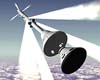
Alliant Techsystems has received a $62.5 million contract from Orbital Sciences Corporation for the main abort motor of the NASA Orion crew exploration vehicle Launch Abort System (LAS). NASA's Orion will succeed the Space Shuttle in transporting humans to and from the International Space Station, as well as carrying crews to the Moon and eventually Mars. |
|
|

| The content herein, unless otherwise known to be public domain, are Copyright 1995-2006 - SpaceDaily.AFP and UPI Wire Stories are copyright Agence France-Presse and United Press International. ESA PortalReports are copyright European Space Agency. All NASA sourced material is public domain. Additionalcopyrights may apply in whole or part to other bona fide parties. Advertising does not imply endorsement,agreement or approval of any opinions, statements or information provided by SpaceDaily on any Web page published or hosted by SpaceDaily. Privacy Statement |