|
 |
 |
 |
 |
 |
 |
 |
 |
 |

| . |  |
. |
Pioneer 10 Still Beats But No Lock
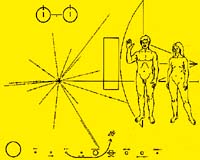
Pasadena - Feb 25, 2003 At a distance of 12.21 billion km from Earth, Pioneer 10 is one of the most distant objects of humanity over 11 light hours out. But with signal strength below what the Deep Space Network can lock on to, all official attempts to contact Pioneer 10 will soon cease.
earlier related report The Pioneer 10 signal was detected on 23 January 2003, but because of limited link time (due to a high-power transmitter trip) no telemetry was received. During uplink on 22 January 2003, the high-power transmitter tripped off. A second high-power transmission was limited to a short time at the end of the track. A GTT-off command was radiated. During downlink on 23 January 2003, the signal was found but there was no lockon to the subcarrier. (Roundtrip Light Time was 22 hours 35 minutes). On 5 December 2002, there was a Pioneer 10 contact. The Deep Space Station (DSS) near Madrid (DSS-63) found the signal but could not lock onto the receiver, and so no telemetry was received. The signal level was just under the threshold value. The uplink from DSS-14 at Goldstone, sent 4 December 2002, at a power level of 325 kw, confirmed that the spacecraft signal is still there (Round Trip Light Time 3D 22 hours 24 minutes). Project Phoenix also picked up the signal at Arecibo in Puerto Rico. Related Links Pioneer 10 Mission Home SpaceDaily Search SpaceDaily Subscribe To SpaceDaily Express  Do Pluto's Other Children Hide In The Shadow Of Charon
 Boulder - Feb 25, 2003
Pluto has only one known satellite - Charon - discovered in 1978 by American astronomer James Christy. At slightly more than half the diameter of Pluto, Charon's 1,200-kilometer diameter makes it the undisputed "relative size" king of solar system satellites. |
|
|

| The content herein, unless otherwise known to be public domain, are Copyright 1995-2006 - SpaceDaily.AFP and UPI Wire Stories are copyright Agence France-Presse and United Press International. ESA PortalReports are copyright European Space Agency. All NASA sourced material is public domain. Additionalcopyrights may apply in whole or part to other bona fide parties. Advertising does not imply endorsement,agreement or approval of any opinions, statements or information provided by SpaceDaily on any Web page published or hosted by SpaceDaily. Privacy Statement |