|
 |
 |
 |
 |
 |
 |
 |
 |
 |

| . |  |
. |
Pioneering 3D View Of Near-Earth Magnetic Dance
Paris, France (ESA) Jul 05, 2007 Scientists have obtained the first-ever 3D picture of interconnected magnetic 'dances' in near-Earth space, known as magnetic reconnection events. The data from ESA's Cluster satellites will help to understand better magnetic reconnection, a process related to star formation, solar explosions and the entry of solar wind energy into the near-Earth environment. Magnetic reconnection is the process whereby magnetic field lines from different magnetic domains collide and reconnect, mixing previously separated plasma. Plasma is a gas composed of ions and electrons but is electrically neutral, spread over large distances in space and guided by the action of magnetic and electric fields. Magnetic reconnection converts the energy of the magnetic field into particle energy, generating jets and heating the plasma. This affects us here on Earth because it can possibly affect telecom satellites and prevent the efficient production of electricity in controlled fusion reactors, potential sources of electricity for the future. On Earth, we can also see the effect in more intense displays of the Northern lights. On 1 October 2001, the four Cluster spacecraft were flying in formation at approximately 110 000 km from Earth in the magnetotail, a long-tail-like structure on the night-side of Earth's magnetic field. The satellites meandered around a reconnection region over a period of nearly 15 minutes. During reconnection, the geometry of the magnetic field forms an X-shape, also called a 'magnetic null'. Analysed in 2D, the magnetic field, plasma density and flow velocity data collected during this event showed that only one reconnection region with an X-shape, or a magnetic null, was seen by the satellites. An international team of scientists led by Chinese researchers challenged this result, suggesting that it could be seen in 3D. The researchers tested theoretical results published 20 years ago, which predicted that any small perturbation to such a reconnection site would produce not one, but two magnetically linked reconnection sites, a pair of magnetic nulls and magnetically linked reconnection geometry. By analysing a subset of the same data in 3D with a higher temporal resolution, they found what they were looking for. Two magnetic reconnection sites jumped out, along with the null-null line which connects two magnetic nulls, a previously unobserved phenomenon. The situation can be compared to viewing a cross section of a 3D volume in space. It is not possible, when looking into only one plane, to tell whether or not something is going on in another plane, in the same volume of space. Only when seen in 3D, with Cluster's multi-satellite viewpoints, could scientists determine that there actually were two, interlinked events occurring simultaneously. When reduced to two dimensions, this complex 3D magnetic geometry is still consistent with past results obtained under the 2D assumption where the null-null line is seen as one X-point. It is also in agreement with past results found in the laboratory and by Cluster in space. "For the first time, the link between two sites of magnetic reconnection has been observed in-situ, in 3-D. This result is another major scientific achievement of Cluster obtained owing to fruitful scientific collaborations between Chinese, American and European scientists", said Philippe Escoubet, Cluster and Double Star project scientist of the European Space Agency. The article "Satellite Observations of Separator Line Geometry of Three-Dimensional Magnetic Reconnection" by C. Xiao, X. Wang, Z. Pu, Z. Ma, H. Zhao, G. Zhou, J. Wang, M. Kivelson, S. Fu, Z. Liu, Q. Zong, M. Dunlop, K-H. Glassmeier, E. Lucek, H. R�me, I. Dandouras, C. Escoubet appeared on 24 June 2007 in the advance online publication of Nature Physics. Community Email This Article Comment On This Article Related Links Cluster Double Star SOHO Solar Orbiter Solar Science News at SpaceDaily
 ESA Spacecraft Flying Closer Than Ever For Better Science
 Paris, France (ESA) Jun 22, 2007
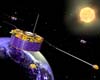
After weeks of manoeuvres, Samba and Tango, two of ESA's four Cluster satellites are now orbiting in formation, separated by only 17 km. This is the closest two ESA satellites have ever been in routine operations and will enable new scientific discoveries. Cluster, ESA's mission comprising four identical satellites, relays the most detailed information ever about how the solar wind affects our planet, and is the first mission to study the Sun-Earth connection in 3D. |
|
|

| The content herein, unless otherwise known to be public domain, are Copyright 1995-2006 - SpaceDaily.AFP and UPI Wire Stories are copyright Agence France-Presse and United Press International. ESA PortalReports are copyright European Space Agency. All NASA sourced material is public domain. Additionalcopyrights may apply in whole or part to other bona fide parties. Advertising does not imply endorsement,agreement or approval of any opinions, statements or information provided by SpaceDaily on any Web page published or hosted by SpaceDaily. Privacy Statement |