. Military Space News .
Planck Satellite On View

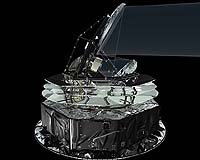
This artist's view shows the Planck satellite and a sketch of the microwave radiation being collected and focussed by the telescope's primary and secondary mirrors. The radiation is then conveyed to the focal planes of the two instruments (LFI Low Frequency Instrument and the HFI High Frequency Instrument). LFI is designed to convert the lower energy microwaves into electrical voltages, rather like a transistor radio. HFI works by converting the higher energy microwaves to heat, which is then measured by a tiny electrical thermometer. Credits: ESA - AOES Medialab
by Staff Writers
Paris, France (ESA) Feb 01, 2007
ESA's Planck satellite, due to study relic radiation from the Big Bang, is on display for the media tomorrow in Cannes. Images of the spacecraft in all its glory will be published on the web at the end of the press conference.

The press conference is organised by ESA and Alcatel Alenia Space (AAS), at the AAS facilities in Cannes, France, on 1 February, to mark the completion of the integration of Planck and to present its technological achievements and scientific objectives.

Planck will make the most accurate maps yet of the microwave background radiation that fills space. It will be sensitive to temperature variations of a few millionths of a degree and will map the full sky in nine wavelengths.

The immediate outcome of the Big Bang and the initial conditions for the evolution in the universe's structure are the primary target of this important mission. From the results, a great deal more will be learnt not only about the nature and amount of dark matter, the 'missing mass' of the universe, but also about the nature of dark energy and the expansion of the universe itself.

To address such challenging objectives, Planck will need to operate at very low, stable temperatures. Once in space, its detectors will have to be cooled to temperature levels close to absolute zero (-273.15C), ranging from -253C to only a few tenths of a degree above absolute zero. The Planck spacecraft thus has to be a marvel of cryotechnology.

After integration, Planck will start a series of tests that will continue into early-2008. It will be launched by end-July 2008 in a dual-launch configuration with Herschel, ESA's mission to study the formation of galaxies, stars and planetary systems in the infrared.

The Planck spacecraft was built by AAS Cannes, the prime contractor, leading a consortium of industrial partners with the AAS industry branch in Turin, Italy, responsible for the satellite's service module. ESA and the Danish National Space Centre (Copenhagen, Denmark) are responsible for the hardware provision of Planck's telescope mirrors, manufactured by EADS Astrium (Friedrichshafen, Germany).

AAS Cannes is also responsible for the payload module, the platform that hosts the telescope and the two onboard instruments, HFI and LFI. The instruments themselves are being supplied by a consortium of scientists and institutes led by the Institut d'Astrophysique Spatiale at Orsay (France) in the case of HFI, and by the Istituto di Astrofisica Spaziale e Fisica Cosmica (IASF) in Bologna (Italy) in that of LFI.

There are also numerous subcontractors spread throughout Europe, with several more in the USA.
Related Links
Herschel overview
Planck overview
Understanding Time and Space

Endless Universe Made Possible By New Model
Chapel Hill NC (SPX) Feb 01, 2007
A new cosmological model demonstrates the universe can endlessly expand and contract, providing a rival to Big Bang theories and solving a thorny modern physics problem, according to University of North Carolina at Chapel Hill physicists.


  • China Takes A Few Shots In The Dark
  • Beyond Putin
  • Japanese Minister Rebuked For Roiling US Alliance
  • China Delivers ASAT Shock Threapy To Western Alliance In Denial

  • US Reluctant To Hold Direct Talks With Iran
  • Iran Will Not Go Unchallenged In Iraq Says US
  • US Hopeful Of Substantial Progress In New North Korean Nuclear Talks
  • North Korea And US To Tackle Sanctions

  • Russia To Help India Test Supersonic Cruise Missile
  • Iran Remains Defiant On Nuclear As Missile Testing Continues
  • Javelin Joint Venture Earns Logistics Award For Supporting The Warfighter
  • Pakistan Chooses Raytheon's Proven Air Defense Missiles To Secure Borders

  • Polish Lawmakers To Debate US Missile Plan
  • Ukraine Denies Reports Of Missile Cooperation With US
  • Successful Missile Defense Intercept Test Takes Place Off Hawaii
  • Russia Criticizes US Missile Shield Plans In Europe

  • Bats In Flight Reveal Unexpected Aerodynamics
  • Lockheed Martin And Boeing Form Strategic Alliance To Promote Next-Gen Air Transportation System
  • Time to test the Guardian Missile Defense System For Commercial Aircraft
  • Operational Testing And Evaluation Of Guardian Commercial Airline Anti-Missile System Begins

  • Iran Builds Hand-Launched Drones
  • Athena Technologies Guidance and Navigation System Selected Watchkeeper UAV Program
  • Enhanced Fire Scout Makes Flight Debut
  • Israel Developing Massive New Unmanned Aerial Vehicle

  • Iraq Beset By Soaring Civilian Death Toll
  • Time Is Short For Iraq Turnaround
  • Dutchman Faces US Iraq Charges
  • A Hopeless Mission For Rice

  • Pentagon Looks To Sci-Fi Weaponry
  • Lockheed Martin Receives Contract For Army, Marine Corps High Mobility Artillery Rocket System
  • L-3 Communications' CyTerra Receives Order From US Army For Handheld Mine Detectors
  • Boeing KC-767 Tanker Completes First Contact With Receiver

  • The content herein, unless otherwise known to be public domain, are Copyright 1995-2006 - SpaceDaily.AFP and UPI Wire Stories are copyright Agence France-Presse and United Press International. ESA PortalReports are copyright European Space Agency. All NASA sourced material is public domain. Additionalcopyrights may apply in whole or part to other bona fide parties. Advertising does not imply endorsement,agreement or approval of any opinions, statements or information provided by SpaceDaily on any Web page published or hosted by SpaceDaily. Privacy Statement