
 |
 |
 |
 |
 |
 |
 |
 |
 |
 |

| . |  |
. |

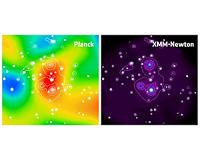
Paris, France (ESA) Jan 14, 2011 The first scientific results from ESA's Planck mission were released at a press briefing in Paris. The findings focus on the coldest objects in the Universe, from within our Galaxy to the distant reaches of space. If William Shakespeare were an astronomer living today, he might write that "All the Universe is a stage, and all the galaxies merely players." Planck is bringing us new views of both the stage and players, revealing the drama of the evolution of our Universe. These results are being presented by the Planck Collaboration at a major scientific conference in Paris this week, based on 25 papers submitted to the journal Astronomy and Astrophysics. The basis of many of these results is the Planck mission's 'Early Release Compact Source Catalogue', the equivalent of a cast list. Drawn from Planck's continuing survey of the entire sky at millimetre and submillimetre wavelengths, the catalogue contains thousands of very cold, individual sources which the scientific community is now free to explore. "This is a great moment for Planck. Until now, everything has been about collecting data and showing off their potential. Now, at last, we can begin the discoveries," says Jan Tauber, ESA Project Scientist for Planck. We can think of the Universe as a stage on which the great cosmic drama plays out over three acts. Visible-light telescopes see little more than the final act: the tapestry of galaxies around us. But by making measurements at wavelengths between the infrared and radio, Planck is able to work back in time and show us the preceding two acts. The results released contain important new information about the middle act, when the galaxies were being assembled. Planck has found evidence for an otherwise invisible population of galaxies shrouded in dust billions of years in the past, which formed stars at rates some 10-1000 times higher than we see in our own Galaxy today. Measurements of this population had never been made at these wavelengths before. "This is a first step, we are just learning how to work with these data and extract the most information," says Jean-Loup Puget, CNRS-Universite Paris Sud, Orsay, France. Eventually, Planck will show us the best views yet of the Universe's first act: the formation of the first large-scale structures in the Universe, where the galaxies were later born. These structures are traced by the cosmic microwave background radiation, released just 380 000 years after the Big Bang, as the Universe was cooling. However, in order to see it properly, contaminating emission from a whole host of foreground sources must first be removed. These include the individual objects contained in the Early Release Compact Source Catalogue, as well as various sources of diffuse emission. This is an important step towards removing this contamination was also announced. The 'anomalous microwave emission' is a diffuse glow most strongly associated with the dense, dusty regions of our Galaxy, but its origin has been a puzzle for decades. However, data collected across Planck's unprecedented wide wavelength range confirm the theory that it is coming from dust grains set spinning at several tens of billion times a second by collisions with either fast-moving atoms or packets of ultraviolet light. This new understanding helps to remove this local microwave 'fog' from the Planck data with greater precision, leaving the cosmic microwave background untouched. "This is a great result made possible by the exceptional quality of the Planck data," says Clive Dickinson, University of Manchester, UK. Among the many other results presented, Planck has shown new details of yet other actors on the cosmic stage: distant clusters of galaxies. These show up in the Planck data as compact silhouettes against the cosmic microwave background. The Planck Collaboration has identified 189 so far, including 20 previously unknown clusters that are being confirmed by ESA's XMM-Newton X-ray observatory. By surveying the whole sky, Planck stands the best chance of finding the most massive examples of these clusters. They are rare and their number is a sensitive probe of the kind of Universe we live in, how fast it is expanding, and how much matter it contains. "These observations will be used as bricks to build our understanding of the Universe," says Nabila Aghanim, CNRS-Universite Paris Sud, Orsay, France. "These results are the tip of the scientific iceberg. Planck is exceeding expectations thanks to the dedication of everyone involved in the project," says David Southwood, ESA Director of Science and Robotic Exploration. "However, beyond those announced, this catalogue contains the raw material for many more discoveries. Even then, we haven't got to the real treasure yet, the cosmic microwave background itself." Planck continues to survey the Universe. Its next data release is scheduled for January 2013 and will reveal the cosmic microwave background in unprecedented detail, the opening act of the cosmic drama, a picture of the beginning of everything.
Share This Article With Planet Earth
Related Links Planck at ESA Understanding Time and Space

 Toronto Astronomers Share In Planck's Treasure Trove Of Science
Toronto, Canada (SPX) Jan 14, 2011 University of Toronto astronomers are in Paris as part of an international conference announcing the first scientific results of the Plank space telescope mission. Launched in May, 2009, the telescope has nearly completed three of its four planned surveys of the entire sky, providing astronomers a glimpse of conditions near the beginning of the Universe and providing data that will help an ... read more |
|
|
| The content herein, unless otherwise known to be public domain, are Copyright 1995-2010 - SpaceDaily. AFP and UPI Wire Stories are copyright Agence France-Presse and United Press International. ESA Portal Reports are copyright European Space Agency. All NASA sourced material is public domain. Additional copyrights may apply in whole or part to other bona fide parties. Advertising does not imply endorsement,agreement or approval of any opinions, statements or information provided by SpaceDaily on any Web page published or hosted by SpaceDaily. Privacy Statement |


 del.icio.us
 Digg
Digg Reddit
 YahooMyWeb
 Google
 Facebook


