
 |
 |
 |
 |
 |
 |
 |
 |
 |
 |

| . |  |
. |

Moffett Field CA (SPX) Feb 25, 2011 Using ESO's Very Large Telescope an international team of astronomers has been able to study the short-lived disc of material around a young star that is in the early stages of making a planetary system. For the first time a smaller companion could be detected that may be the cause of the large gap found in the disc. Future observations will determine whether this companion is a planet or a brown dwarf. Planets form from the discs of material around young stars, but the transition from dust disc to planetary system is rapid and few objects are caught during this phase. One such object is T Chamaeleontis (T Cha), a faint star in the small southern constellation of Chamaeleon that is comparable to the Sun, but very near the beginning of its life. T Cha lies about 350 light-years from the Earth and is only about seven million years old. Up to now no forming planets have been found in these transitional discs, although planets in more mature discs have been seen before. "Earlier studies had shown that T Cha was an excellent target for studying how planetary systems form," notes Johan Olofsson (Max Planck Institute for Astronomy, Heidelberg, Germany), one of the lead authors of two papers in the journal Astronomy and Astrophysics that describe the new work. "But this star is quite distant and the full power of the Very Large Telescope Interferometer (VLTI) was needed to resolve very fine details and see what is going on in the dust disc." The astronomers first observed T Cha using the AMBER instrument and the VLT Interferometer (VLTI). They found that some of the disc material formed a narrow dusty ring only about 20 million kilometers from the star. Beyond this inner disc, they found a region devoid of dust with the outer part of the disc stretching out into regions beyond about 1.1 billion kilometers from the star. Nuria Huelamo (Centro de Astrobiologia, ESAC, Spain), the lead author of the second paper, takes up the story: "For us the gap in the dust disc around T Cha was a smoking gun, and we asked ourselves: could we be witnessing a companion digging a gap inside its protoplanetary disc?" However, finding a faint companion so close to a bright star is a huge challenge and the team had to use the VLT instrument NACO in a novel and powerful way, called sparse aperture masking, to reach their goal. After careful analysis they found the clear signature of an object located within the gap in the dust disc, about one billion kilometers from the star - slightly further out than Jupiter is within our solar system and close to the outer edge of the gap. This is the first detection of an object much smaller than a star within a gap in the planet-forming dust disc around a young star. The evidence suggests that the companion object cannot be a normal star but it could be either a brown dwarf surrounded by dust or, most excitingly, a recently-formed planet. Huelamo concludes: "This is a remarkable joint study that combines two different state-of-the-art instruments at ESO's Paranal Observatory. Future observations will allow us to find out more about the companion and the disc, and also understand what fuels the inner dusty disc."
Share This Article With Planet Earth
Related Links ESO Lands Beyond Beyond - extra solar planets - news and science Life Beyond Earth

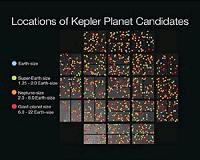 Kepler Triples ExoPlanet Count As Search For Biosphere 2 Intensifies
Eureka, CA (SPX) Feb 21, 2011 The rush of data released earlier this month from the Kepler science team is intriguing for what it saw and didn't see in its first 4 months of observations. The relatively small Kepler space telescope is very good at what it does. It has a highly sensitive array of CCDs (light sensors) that has taken about 21 months of data. We saw the release of a small part of that data recently. It rev ... read more |
|
|
| The content herein, unless otherwise known to be public domain, are Copyright 1995-2010 - SpaceDaily. AFP and UPI Wire Stories are copyright Agence France-Presse and United Press International. ESA Portal Reports are copyright European Space Agency. All NASA sourced material is public domain. Additional copyrights may apply in whole or part to other bona fide parties. Advertising does not imply endorsement,agreement or approval of any opinions, statements or information provided by SpaceDaily on any Web page published or hosted by SpaceDaily. Privacy Statement |


 del.icio.us
 Digg
Digg Reddit
 YahooMyWeb
 Google
 Facebook


