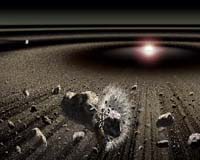
Illustration by Kouji Kanba.
Illustration by Kouji Kanba. |
A team of astronomers from Ibaraki University, the Japan Aerospace Exploration Agency, the University of Tokyo, and the National Astronomical Observatory of Japan has observed the dust disk of beta Pictoris using the Subaru telescope and an instrument called the Cooled Mid-Infrared Camera and Spectrometer (COMICS).
By analyzing the infrared dust band emission, the team discovered that small amorphous silicate grains have their distribution peaks around 6, 16, and 30AU (1AU = 1.5x10**8km = the distance between the earth and the sun).
Since the small grains are blown-out very quickly from the system due to the stellar radiation pressure on the dust, the team concluded that the grains are replenished at ring-like locations around 6, 16, and 30AU, which are conceivable as ring-like distributions of planetesimals, or 'planetesimal belts', like the asteroid belt in our Solar system.
The beautiful illustration shows an imaginary picture of the planetesimal belts and the aspect that the grains are replenished by collisions between the planetesimals.
Current results have revealed inner structure of a forming planetary system by probing the locations of grain replenishment. In particular the regions probed by the team here correspond to the radius where planets exist in our Solar system. Detailed structure of such inner region has been revealed for the first time thanks to the mid-infrared high-resolution observations.
The results here have a large impact on the study of planetary system formation. Perhaps, our Solar system has shown a similar aspect and frequent collisions of planetesimals have occurred at its young age, too.
The results here have been published as a paper in Nature in October 2004.
Reference: Okamoto, Y. K. et al. Nature, Vol. 431, pp.660-663 (2004)
Related Links
 Astronomers Discover Planet Building Is Big Mess
 Tucson AZ (SPX) Oct 19, 2004
| The content herein, unless otherwise known to be public domain, are Copyright 1995-2006 - SpaceDaily.AFP and UPI Wire Stories are copyright Agence France-Presse and United Press International. ESA PortalReports are copyright European Space Agency. All NASA sourced material is public domain. Additionalcopyrights may apply in whole or part to other bona fide parties. Advertising does not imply endorsement,agreement or approval of any opinions, statements or information provided by SpaceDaily on any Web page published or hosted by SpaceDaily. Privacy Statement |