
Subscribe free to our newsletters via your
. Military Space News .


BIO FUEL
Plants' Oil-Desaturating Enzymes Pair Up to Channel Metabolites
by Staff Writers
Upton NY (SPX) May 13, 2014


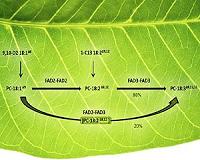
Metabolic channeling: Scientists traced the pathways by which plant oils were desaturated by fatty acid desaturase (FAD) enzymes. Two subsequent desaturating steps could be performed by two different "homodimers"-pairs of identical FADs (FAD2-FAD2 followed by FAD3-FAD3)-or by a heterodimer comprised of FAD2 associated with FAD3. This latter pathway channeled the fatty acid through both desaturation steps without releasing the intermediate compound into the general cell metabolite pool. Engineering such enzyme interactions could offer new ways to direct plant metabolism towards new desired products-for example, polyunsaturated oils or rare fatty acids that could serve as feedstocks for industrial processes.

Plant scientists at the U.S. Department of Energy's Brookhaven National Laboratory have found that certain enzymes responsible for desaturating fatty acids, the building blocks of oils, can link up to efficiently pass intermediate products from one enzyme to another.

"Engineering these enzyme interactions to channel metabolites along desired metabolic pathways could be a new approach for tailoring plants to produce useful products," said Brookhaven biochemist John Shanklin, lead author on a paper reporting the results in the Journal of Biological Chemistry.

Getting plants to accumulate high levels of more healthful polyunsaturated fatty acids, or unusual fatty acids that could be used as raw materials in place of petroleum-derived chemicals in industrial processes, are a few possible outcomes.

The idea would be to take advantage of a process called metabolic channeling, wherein enzymes that act sequentially in a particular metabolic pathway interact with each other so that they are able to pass molecules to each other without them entering the general metabolite pool of the cell. This close arrangement of enzymes also prevents intermediates from entering the metabolic channel.

Previous studies by Shanklin's group had shown that a distinct kind of desaturase enzyme that floats freely in plant plastids-mini plant cell "organs" where many metabolic processes, including photosynthesis, take place-pair up with themselves to form structures called dimers.

The group had also studied baker's yeast and determined that its membrane-bound desaturase formed dimers too. But no studies had looked for these kinds of macromolecular arrangements in membrane-bound desaturases, called FADs, in higher plants.

The current study used a molecular-genetic approach to explore the organization of membrane desaturases found in the plastids and endoplasmic reticulum (another membrane structure inside cells) of Arabidopsis, a common experimental plant.

Ying Lou, a postdoctoral research fellow working in Shanklin's lab, used several independent methods of bi-molecular complementation-methods that produce a signal if two test proteins come together-to establish which desaturases interact with themselves or others.

The scientists found that all the plant membrane desaturases they examined are capable of forming self-associating dimers in plant cells-pairings of two identical desaturase enzyme molecules. They also found that certain desaturases with different functions could also pair up, but others could not.

"The naturally pairing enzymes turn out to have interesting patterns," Shanklin said. "They are found in the same subcellular locations within the cell, and are involved in subsequent steps of the same metabolic pathway, suggesting a physiological driver for the observed pairings.

"Other pairings between very similar desaturases from different locations that we expected to pair up didn't," he added.

To test the idea that the paired enzymes were working together, the scientists conducted another series of experiments called metabolic flux analysis, drawing on Brookhaven biochemist Jorg Schwender's expertise. This method follows mass-labeled compounds through the various reaction pathways.

"Think of a city map with lots of ways to get from A to B. This method traces how many molecules travel along each route," Schwender said.

The analysis showed that one of the natural enzyme pairings performed two steps of a particular metabolic process without releasing an intermediate product.

"This was clear evidence that these two linked enzymes were working in concert to channel metabolites through this metabolic pathway in an efficient manner in living plant cells," Shanklin said.

"Our findings suggest genetic techniques may be used to engineer these kinds of interactions into other desaturase enzymes-including enzymes that don't associate naturally-to push metabolites along desired pathways to produce useful products."

Scientific paper: "FAD2 and FAD3 Desaturases Form Hetero-dimers That Facilitate Metabolic Channeling in vivo"

.


Related Links
Brookhaven National Laboratory
Bio Fuel Technology and Application News


Comment on this article via your Facebook, Yahoo, AOL, Hotmail login.

Share this article via these popular social media networks
del.icio.usdel.icio.us DiggDigg RedditReddit GoogleGoogle


BIO FUEL
SE Asia palm oil problems could hit consumers worldwide
Jakarta (AFP) May 11, 2014
Southeast Asia's booming palm oil industry is facing a double blow from a recent drought and a possible El Nino weather phenomenon later this year, with analysts warning a production shortfall could spark a jump in consumer goods prices. From biscuits to shampoo and make-up, the oil has become a key ingredient in numerous products found on supermarket shelves across the globe, fuelling rapid ... read more


BIO FUEL
Propulsion Module For SBIRS GEO-4 Satellite Completed

Canada revisiting ballistic missile defense: official

South Korea orders missile defense systems from ATK

Army orders Patriot missile segment enhancement

BIO FUEL
Advanced Precision Kill Weapon System rockets for Jordan

Raytheon's JSOW scores direct hits in back-to-back flight tests

Britain eyes adaption of naval air defense missile for army

Harpoon missile sale in works for Brazil

BIO FUEL
Parrot launching smartphone-controlled drones

Iran says it has copied US drone

S. Korea has 'smoking gun' proof North sent drones

Electromagnetic environment testing for MQ-8C Fire Scout

BIO FUEL
China to deter unauthorized use of radio frequency

Testing facility paves way for more radio connections to MUOS satellites

LGS Innovations completes upgrade of Army communications center in Kuwait

Britain contracts General Dynamics UK to support Bowman radios

BIO FUEL
Stryker hulls being improved to withstand mines, IEDs

Exelis receives follow-on order for CWI sub-systems

Beetle uses chemical warfare, inspires ATM protection technology

Japan makes first arrest over 3-D printer guns: reports

BIO FUEL
Pentagon chief to head to Saudi, Israel next week

India's Modi pledges defence procurement overhaul

US military reviews hairstyle rules after outcry

EU firms help power China's military rise

BIO FUEL
Philippines' Aquino says ASEAN must tackle China sea claims

Rebels in east Ukraine claim landslide vote for independence

Myanmar diplomatic debut tested by China sea spats

ASEAN fires warning shot across China's bows

BIO FUEL
Nanoscale heat flow predictions

Harnessing Magnetic Vortices for Making Nanoscale Antennas

New method for measuring the temperature of nanoscale objects discovered

Nanomaterial Outsmarts Ions


The content herein, unless otherwise known to be public domain, are Copyright 1995-2014 - Space Media Network. All websites are published in Australia and are solely subject to Australian law and governed by Fair Use principals for news reporting and research purposes. AFP, UPI and IANS news wire stories are copyright Agence France-Presse, United Press International and Indo-Asia News Service. ESA news reports are copyright European Space Agency. All NASA sourced material is public domain. Additional copyrights may apply in whole or part to other bona fide parties. Advertising does not imply endorsement, agreement or approval of any opinions, statements or information provided by Space Media Network on any Web page published or hosted by Space Media Network. Privacy Statement All images and articles appearing on Space Media Network have been edited or digitally altered in some way. Any requests to remove copyright material will be acted upon in a timely and appropriate manner. Any attempt to extort money from Space Media Network will be ignored and reported to Australian Law Enforcement Agencies as a potential case of financial fraud involving the use of a telephonic carriage device or postal service.