|
 |
 |
 |
 |
 |
 |
 |
 |
 |

| . |  |
. |
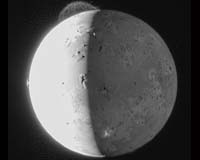
Plume Of Tvashtar Rises From Io
Laurel MD (SPX) Mar 06, 2007 This dramatic image of Io was taken by the Long Range Reconnaissance Imager (LORRI) on New Horizons at 11:04 Universal Time on February 28, 2007, just about 5 hours after the spacecraft's closest approach to Jupiter. The distance to Io was 2.5 million kilometers (1.5 million miles) and the image is centered at 85 degrees west longitude. At this distance, one LORRI pixel subtends 12 kilometers (7.4 miles) on Io. This processed image provides the best view yet of the enormous 290-kilometer (180-mile) high plume from the volcano Tvashtar, in the 11 o'clock direction near Io's north pole. The plume was first seen by the Hubble Space Telescope two weeks ago and then by New Horizons on February 26; this image is clearer than the February 26 image because Io was closer to the spacecraft, the plume was more backlit by the Sun, and a longer exposure time (75 milliseconds versus 20 milliseconds) was used. Io's dayside was deliberately overexposed in this picture to image the faint plumes, and the long exposure also provided an excellent view of Io's night side, illuminated by Jupiter. The remarkable filamentary structure in the Tvashtar plume is similar to details glimpsed faintly in 1979 Voyager images of a similar plume produced by Io's volcano Pele. However, no previous image by any spacecraft has shown these mysterious structures so clearly. The image also shows the much smaller symmetrical fountain of the plume, about 60 kilometers (or 40 miles) high, from the Prometheus volcano in the 9 o'clock direction. The top of a third volcanic plume, from the volcano Masubi, erupts high enough to catch the setting Sun on the night side near the bottom of the image, appearing as an irregular bright patch against Io's Jupiter-lit surface. Several Everest-sized mountains are highlighted by the setting Sun along the terminator, the line between day and night. This is the last of a handful of LORRI images that New Horizons is sending "home" during its busy close encounter with Jupiter - hundreds of images and other data are being taken and stored onboard. The rest of the images will be returned to Earth over the coming weeks and months as the spacecraft speeds along to Pluto. Email This Article
Related Links  Baltimore MD (SPX) Oct 11, 2006
The highest wind speeds in Jupiter's Little Red Spot have increased and are now equal to those in its older and larger sibling, the Great Red Spot, according to observations with NASA's Hubble Space Telescope. The Little Red Spot's winds, now raging up to approximately 400 miles per hour, signal that the storm is growing stronger, according to the NASA-led team that made the Hubble observations. The increased intensity of the storm probably caused it to change color from its original white in late 2005, according to the team. |
|
|

| The content herein, unless otherwise known to be public domain, are Copyright 1995-2006 - SpaceDaily.AFP and UPI Wire Stories are copyright Agence France-Presse and United Press International. ESA PortalReports are copyright European Space Agency. All NASA sourced material is public domain. Additionalcopyrights may apply in whole or part to other bona fide parties. Advertising does not imply endorsement,agreement or approval of any opinions, statements or information provided by SpaceDaily on any Web page published or hosted by SpaceDaily. Privacy Statement |