|
 |
 |
 |
 |
 |
 |
 |
 |
 |

| . |  |
. |
Pluto-Charon Origin May Mirror That Of Earth And Its Moon
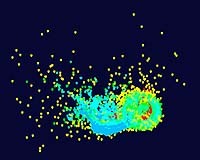
Boulder CO (SPX) Feb 01, 2005 The evolution of Kuiper Belt objects, Pluto and its lone moon Charon may have something in common with Earth and our single Moon: a giant impact in the distant past. Dr. Robin Canup, assistant director of Southwest Research Institute's (SwRI) Department of Space Studies, argues for such an origin for the Pluto-Charon pair in an article for the January 28 issue of the journal Science. Canup, who currently is a visiting professor at the California Institute of Technology, has worked extensively on a similar "giant collision" scenario to explain the Moon's origin. In both the Earth-Moon and Pluto-Charon cases, Canup's smooth particle hydrodynamic simulations depict an origin in which a large, oblique collision with the growing planet produced its satellite and provided the current planet-moon system with its angular momentum. While the Moon has only about 1 percent of the mass of Earth, Charon accounts for a much larger 10 to 15 percent of Pluto's total mass. Canup's simulations suggest that a proportionally much larger impactor - one nearly as large as Pluto itself - was responsible for Charon, and that the satellite likely formed intact as a direct result of the collision. According to Canup, a collision in the early Kuiper Belt - a disk of comet-like objects orbiting in the outer solar system beyond Neptune - could have given rise to a planet and satellite with relative sizes and angular rotation characteristics consistent with those of the Pluto-Charon pair. The colliding objects would have been about 1,600 to 2,000 kilometers in diameter, or each about half the size of the Earth's Moon. "This work suggests that despite their many differences, our Earth and the tiny, distant Pluto may share a key element in their formation histories. This provides further support for the emerging view that stochastic impact events may have played an important role in shaping final planetary properties in the early solar system," said Canup. The "giant impact" theory was first proposed in the mid-1970s to explain how the Moon formed, and a similar mode of origin was suggested for Pluto and Charon in the early 1980s. Canup's simulations are the first to successfully model such an event for the Pluto-Charon pair. Simulations published by Canup and a colleague in Nature in 2001 showed that a single impact by a Mars-sized object in the late stages of Earth's formation could account for the iron-depleted Moon and the masses and angular momentum of the Earth-Moon system. This was the first model to simultaneously explain these characteristics without requiring that the Earth-Moon system be substantially modified after the lunar forming impact. Related Links SWRI SpaceDaily Search SpaceDaily Subscribe To SpaceDaily Express  SwRI Researchers Show Planetoid Sedna May Have Formed Far Beyond Pluto
 Boulder CO (SPX) Jan 12, 2005
Recently, astronomers reported the surprising discovery of a very large diameter Kuiper Belt planetoid - (90377) Sedna - on a distant, 12,500-year-long, eccentric orbit centered approximately 500 astronomical units from the Sun. |
|
|

| The content herein, unless otherwise known to be public domain, are Copyright 1995-2006 - SpaceDaily.AFP and UPI Wire Stories are copyright Agence France-Presse and United Press International. ESA PortalReports are copyright European Space Agency. All NASA sourced material is public domain. Additionalcopyrights may apply in whole or part to other bona fide parties. Advertising does not imply endorsement,agreement or approval of any opinions, statements or information provided by SpaceDaily on any Web page published or hosted by SpaceDaily. Privacy Statement |