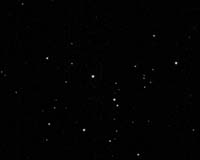
LORRI's first image in space, of Messier 7, a star cluster in our Milky Way galaxy. Credit: NASA/Johns Hopkins University Applied Physics Laboratory/Southwest Research Institute.
LORRI's first image in space, of Messier 7, a star cluster in our Milky Way galaxy. Credit: NASA/Johns Hopkins University Applied Physics Laboratory/Southwest Research Institute. |
This week the Long Range Reconnaissance Imager (LORRI) opened its protective cover and took its first image in space, of Messier 7, a star cluster in our Milky Way galaxy. The electronic snapshot also meant that all seven New Horizons science instruments have now operated in space and returned good data since the spacecraft launched in January 2006.
Developed by the Johns Hopkins University Applied Physics Laboratory (APL), which also built and operates the New Horizons spacecraft, LORRI is the long focal length, reflecting telescope on New Horizons, designed to acquire the highest-resolution images of Pluto and its moons during a flyby in summer 2015.
"LORRI is our 'eagle eyes' on New Horizons, providing the most detailed images we have," says New Horizons Principal Investigator Alan Stern, of the Southwest Research Institute (SwRI), Boulder, Colo. "This week's virtuoso first-light performance by LORRI is the best news any Pluto fan could hope for."
Operating on commands stored in the spacecraft's computer, the hinged cover door popped open just after 2:40 a.m. EDT on Aug. 29, and LORRI snapped its first image about five and a half minutes later. Data reached the APL Mission Operations Center in Maryland during a scheduled connection through NASA's Deep Space Network just after 11 a.m. EDT. First came data that temperatures on the camera were cooling, indicating that the door had opened. Then the image arrived on operators' screens. "I see stars!" said APL's Steve Conard, who led the engineering team that built and tested LORRI.
"Our hope was that LORRI's first image would prove not only that the cover had opened completely, but that LORRI was capable of providing the required high-resolution imaging of Pluto and Charon," says Andy Cheng, LORRI principal investigator, from APL. "Our hopes were not only met, but exceeded."
The image shows the center of the famous star cluster Messier 7, which was catalogued by Charles Messier in 1764, and described by Ptolemy around 130 A.D. Stars to at least 12th magnitude are clearly visible, meaning LORRI's sensitivity and noise levels in space are consistent with its pre-launch calibrations on the ground.
LORRI is a panchromatic high-magnification imager, consisting of a telescope with an 8.2-inch (20.8-centimeter) aperture that focuses visible light onto a charge-coupled device (CCD). It's essentially a digital camera with a large telephoto telescope, only fortified to operate in the cold, hostile environs near Pluto. LORRI has no color filters or moving parts; operators take images by pointing the LORRI side of the spacecraft at their target. The instrument's silicon carbide construction kept its mirror focused even after the its temperature plunged by more than 120 degrees F (50 degrees C) once the door opened. LORRI is now approximately at the same temperature it will be when takes close-up images of Pluto nine years from now.
Before then LORRI will focus on the Jupiter system, taking its first pictures of the giant planet on Sept. 4. Next Feb. 28 the spacecraft will pass within 1.4 million miles (2.27 million kilometers) of Jupiter, getting a gravity assist toward Pluto and training its instruments on Jupiter and several jovian moons. While there, LORRI will study many aspects of Jupiter, including the planet's weather and aurora, its rings, and its fascinating satellite system.
Related Links
 The Fightback Begins To Save Pluto
 Paris (AFP) Sept 1, 2006
| The content herein, unless otherwise known to be public domain, are Copyright 1995-2006 - SpaceDaily.AFP and UPI Wire Stories are copyright Agence France-Presse and United Press International. ESA PortalReports are copyright European Space Agency. All NASA sourced material is public domain. Additionalcopyrights may apply in whole or part to other bona fide parties. Advertising does not imply endorsement,agreement or approval of any opinions, statements or information provided by SpaceDaily on any Web page published or hosted by SpaceDaily. Privacy Statement |