|
 |
 |
 |
 |
 |
 |
 |
 |
 |

| . |  |
. |
Pluto Bound Spacecraft Shipped To Goddard For Pre-launch Tests
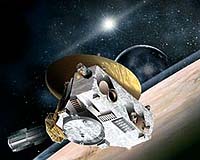
Greenbelt MD (SPX) Jun 14, 2005 The first spacecraft designed to study Pluto, the solar system's farthest planet, took the first steps on a long journey today when it was shipped from the Johns Hopkins University Applied Physics Laboratory (APL) in Laurel, Md. - where it was designed and built - to NASA's Goddard Space Flight Center for its next round of pre-launch tests. Proposed for launch in January 2006, the New Horizons spacecraft spent the past week in an APL vibration test lab, where engineers checked the structural integrity of the piano-sized probe aboard a large shake table. The table simulated the energetic ride New Horizons would encounter during liftoff aboard an Atlas V - one of the largest launch vehicles NASA uses. "Our testing program is off to a good start," says Glen Fountain, New Horizons project manager at APL. "We've shown that New Horizons is structurally ready for the ride on the launch vehicle, and now we'll test it in the full range of conditions it would face on the voyage to Pluto, Pluto's moon, Charon, and beyond." Over the next three months at Goddard the mission team will check New Horizons' balance and alignment in a series of spin tests; put it before wall-sized speakers that simulate the noise-induced vibrations of launch; and seal it in a four-story thermal-vacuum chamber that duplicates the extreme hot, cold and airless conditions of space. This fall the team plans to transport New Horizons to Kennedy Space Center, Fla., for final launch preparations. "The scientific community has put high priority on exploring the frontier that is the Pluto system and the Kuiper Belt beyond," says Dr. Alan Stern, New Horizons principal investigator, from the Southwest Research Institute in Boulder, Colo. "With the move of New Horizons from APL to NASA's Goddard Space Flight Center, we are closer to achieving this historic exploration." Pending completion of environmental reviews and launch approvals, the spacecraft would launch from Cape Canaveral Air Force Station, Fla., during a 35-day window that opens Jan. 11, 2006. The boost from the Atlas V and a STAR-48B kick motor would send the relatively light New Horizons on the fastest spacecraft trip ever to the outer solar system, reaching the moon's orbit distance less than 9 hours after launch and zooming through the Jupiter system just 13 months later. Jupiter's gravity assist would put the 1,000-pound craft on course for a five-month-long flyby reconnaissance of Pluto-Charon in summer 2015, when the "double planet" would be about 3.1 billion miles from Earth. As part of an extended mission, the spacecraft could also head farther into the Kuiper Belt to examine one or two of the ancient, icy mini-worlds in the vast region at least a billion miles beyond Neptune's orbit. Related Links Pluto at APL SpaceDaily Search SpaceDaily Subscribe To SpaceDaily Express  Planners Eye Next Stage Of New Horizons Pluto Mission
 Greenbelt MD (SPX) May 26, 2005
Pluto might be about 3 billion miles from Earth, but it seems a little closer for the team leading NASA's proposed first mission to the "last planet." |
|
|

| The content herein, unless otherwise known to be public domain, are Copyright 1995-2006 - SpaceDaily.AFP and UPI Wire Stories are copyright Agence France-Presse and United Press International. ESA PortalReports are copyright European Space Agency. All NASA sourced material is public domain. Additionalcopyrights may apply in whole or part to other bona fide parties. Advertising does not imply endorsement,agreement or approval of any opinions, statements or information provided by SpaceDaily on any Web page published or hosted by SpaceDaily. Privacy Statement |